A broadcast link, can have multiple sending and receiving nodes all connected to the same, single, shared broadcast channel. The term broadcast is used here because when any one node transmits a frame, the channel broadcasts the frame and each of the other nodes receives a copy. Ethernet and wireless LANs are examples of broadcast link-layer technologies.
Because all nodes are capable of transmitting frames, more than two nodes can transmit frames at the same time. When this happens, all of the nodes receive multiple frames at the same time; that is, the transmitted frames collide at all of the receivers. Typically, when there is a collision, none of the receiving nodes can make any sense of any of the frames that were transmitted; in a sense, the signals of the colliding frames become inextricably tangled together. Thus, all the frames involved in the collision are lost, and the broadcast channel is wasted during the collision interval.
Static Channelization
FDM, TDM, CDMA, Inefficient for bursty traffic.
Random Access Protocols
In a random access protocol, a transmitting node always transmits at the full rate of the channel, namely, R bps. When there is a collision, each node involved in the collision repeatedly retransmits its frame (that is, packet) until its frame gets through without a collision.
ALOHA
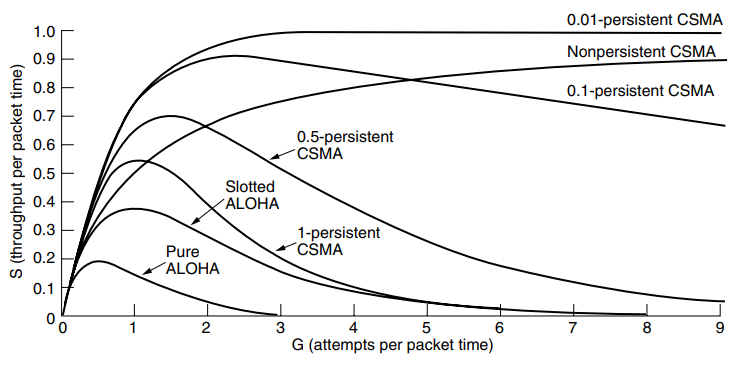
Each station sends its frame to a central computer, Center rebroadcasts which sending station can listen to see if frame has gotten through, Might as well listen for collision while transmitting, On collision, waits a random time, before sending again. Vulnerable time is twice the transmission time, When (re)transmissions are modeled by Poisson with mean of G, throughput efficiecny Maximum throughput at with utlilization .
Slotted ALOHA
Divide into discrete time slots each interval corresponding to one frame, Stations wait for the beginning of the next slot to send the packets, On collision, re-transmits with a probability , Agree on slot boundaries, Special station emits a pip at the start of each interval, Halves the vulnerable period, Peaks at , with a throughput of ,
Carrier Sense Multiple Access
With ALOHAs, the best channel utilization that can be achieved is . This low result is hardly surprising, since with stations transmitting at will, without knowing what the other stations are doing there are bound to be many collisions. In LANs, however, it is often possible for stations to detect what other stations are doing, and thus adapt their behavior accordingly. These networks can achieve a much better utilization than 1/e.
When a station has data to send, it first listens to the channel to see if anyone else is transmitting at that moment. If the channel is idle, the stations sends its data. Otherwise, if the channel is busy, the station just waits until it becomes idle. Then the station transmits a frame. If a collision occurs, the station waits a random amount of time and starts all over again.
If two stations become ready in the middle of a third station’s transmission, both will wait politely until the transmission ends, and then both will begin transmitting exactly simultaneously, resulting in a collision.
Another improvement is for the stations to quickly detect the collision and abruptly stop transmitting, (rather than finishing them) since they are irretrievably garbled anyway. This strategy saves time and bandwidth. This protocol, known as CSMA/CD (CSMA with Collision Detection), is the basis of the classic Ethernet LAN. (Ethernet)
It is important to realize that collision detection is an analog process. The station’s hardware must listen to the channel while it is transmitting. If the signal it reads back is different from the signal it is putting out, it knows that a collision is occurring. The implications are that a received signal must not be tiny compared to the transmitted signal (which is difficult for wireless, as received signals may be 1,000,000 times weaker than transmitted signals) and that the modulation must be chosen to allow collisions to be detected (e.g., a collision of two 0- volt signals may well be impossible to detect).
At the point marked t 0, a station has finished transmitting its frame. Any other station having a frame to send may now attempt to do so. If two or more stations decide to transmit simultaneously, there will be a collision. If a station detects a collision, it aborts its transmission, waits a random period of time, and then tries again (assuming that no other station has started transmitting in the meantime). Therefore, our model for CSMA/CD will consist of alternating contention and transmission periods, with idle periods occurring when all stations are quiet (e.g., for lack of work).
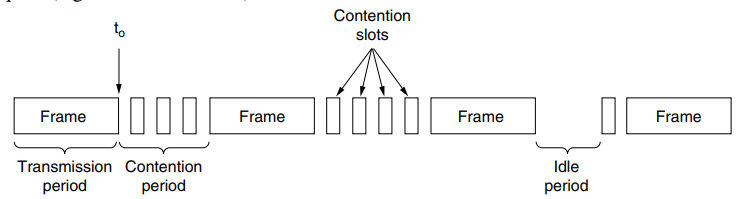
Suppose that two stations both begin transmitting at exactly time t 0. How long will it take them to realize that they have collided? The answer is vital to determining the length of the contention period and hence what the delay and throughput will be.
The minimum time to detect the collision is just the time it takes the signal to propagate from one station to the other. Based on this information, you might think that a station that has not heard a collision for a time equal to the full cable propagation time after starting its transmission can be sure it has seized the cable. This conclusion is wrong.
In other words, in the worst case a station cannot be sure that it has seized the channel until it has transmitted for 2τ without hearing a collision.
With this understanding, we can think of CSMA/CD contention as a slotted ALOHA with a slot width of . On a long 1-km long coaxial cable sec.
(bhanesi aba aloha ma transmission time thiyo yesma chai propagation time ho)
In nonpersistent CSMA protocol, a conscious attempt is made to be less greedy than in the previous one. As before, a station senses the channel when it wants to send a frame, and if no one else is sending, the station begins doing so itself. However, if the channel is already in use, the station does not continually sense it for the purpose of seizing it immediately upon detecting the end of the previous transmission. Instead, it waits a random period of time and then repeats the algorithm.
The last protocol is p-persistent CSMA. When a station becomes ready to send, it senses the channel. If it is idle, it transmits with a probability p. With a probability q = 1 − p, it defers until the next slot. If that slot is also idle, it either transmits or defers again, with probabilities p and q. This process is repeated until either the frame has been transmitted or another station has begun transmitting. IEEE 802.11 uses a refinement of p-persistent CSMA. (WiFi)
Taking Turns Protocols
Polling One node designated as a master node, Polls each of the nodes in round-robin fashion, Sends a message to each allowing to transmit up to a maximum number of frames.
Token Passing A special purpose frame exchanged among the nodes in some fixed order, Holds onto the token only if has some frames to transmit, Can send up to a maximum number of frames,