Xv6 memory management connects physical page allocation, kernel virtual memory, and per-process user virtual memory.
--- config: layout: dagre --- flowchart LR BOOT["kernel VM setup<br><br>kinit<br>kvminit<br>proc_mapstacks<br>kvminithart"] -- initializes --> PMA["physical page allocator<br><br>kalloc<br>kfree<br>kmem.freelist"] BOOT -- builds and enables --> KVM["kernel virtual memory<br><br>kernel_pagetable<br>direct map<br>kernel stacks<br>trampoline"] PMA -- "supplies 4096-byte pages to" --> KVM & PROCVM["process virtual memory<br><br>p->pagetable<br>kexec<br>kfork<br>sys_sbrk / growproc<br>p->sz"] PROCVM -- uses --> VMAPI["VM helper functions<br><br>walk<br>mappages<br>uvmalloc<br>uvmunmap<br>copyin / copyout<br>vmfault"] VMAPI -- creates / edits mappings to --> PHYS["physical memory + MMIO<br><br>RAM<br>page-table pages<br>user pages<br>trapframe page<br>trampoline page<br>UART / VIRTIO / PLIC"] HW["RISC-V translation backend<br><br>satp<br>TLB<br>Sv39 hardware walker<br>page fault"] -- uses active page table to access --> PHYS KVM -- selected in kernel mode by satp --> HW PROCVM -- selected in user mode by satp --> HW BOOT:::iface PMA:::iface KVM:::source PROCVM:::source VMAPI:::iface HW:::backend PHYS:::source classDef process fill:#F3EFE2,stroke:#111,stroke-width:2px,color:#111 classDef file fill:#FFFFFF,stroke:#111,stroke-width:3px,color:#111 classDef source fill:#E9F1FF,stroke:#111,stroke-width:2px,color:#111 classDef iface fill:#EDE7D4,stroke:#111,stroke-width:2px,color:#111 classDef backend fill:#F8F8F8,stroke:#111,stroke-width:2px,color:#111
Paging
The page tables are the most popular mechanism through which the operating system provides each process with its own private address space and memory.
- RISC-V instructions manipulate virtual addresses, while the machine’s RAM uses physical addresses.
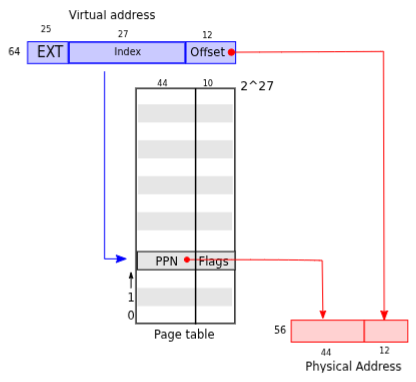
- The Sv39 RISC-V architecture utilizes only the bottom 39 bits of a 64-bit virtual address, ignoring the top 25 bits.
- The page table structure physically maps these addresses:
- Logically acts as an array of Page Table Entries (PTEs).
- Each PTE translates a virtual address to a physical address at the granularity of a 4096-byte ( bytes) page.
- A PTE contains a 44-bit Physical Page Number (PPN) and hardware control flags.
- The CPU constructs a 56-bit physical address by combining the 44-bit PPN from the PTE with the bottom 12 bits of the original virtual address.
RISC-V virtual and physical addresses, with a simplified logical page table:
- Three-level tree implementation:
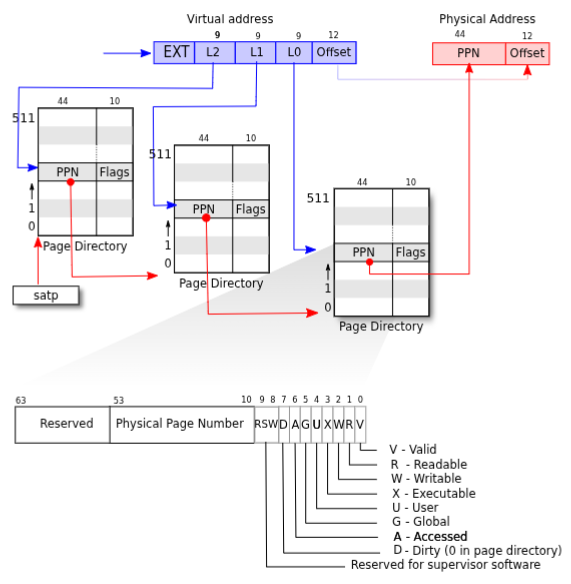
- A page table is stored in physical memory as a three-level tree of 4096-byte pages.
- The root page contains 512 PTEs pointing to intermediate pages, which point to bottom-level pages containing the final physical mappings.
- The 27-bit virtual page number is split into three 9-bit sections to index into each of the three levels.
- This tree structure saves physical memory by omitting entirely unmapped intermediate and bottom-level page directories.
RISC-V address translation details:
- Hardware integration:
- The Translation Look-aside Buffer (TLB) caches PTEs inside the CPU to eliminate the performance cost of loading PTEs from memory during every address translation.
- The
satpregister holds the physical address of the root page-table page, telling the CPU which page table tree to use for the currently executing thread.
- PTE flags control access permissions:
PTE_V: Indicates the PTE is present and valid.PTE_R,PTE_W,PTE_X: Control read, write, and execute permissions, respectively.PTE_U: Allows access by instructions executing in user mode.- Note:
PTE_Uis per-page, not per-page-table; xv6 maps pages like the trapframe in a user process’s page table so trap entry/return code can access them, but clearsPTE_Uso user-mode code cannot read or modify kernel-owned state.
Memory Allocation
The kernel manages physical memory between the end of the kernel binary and PHYSTOP as a global pool of 4096-byte pages.
The allocator stores free pages in a linked list.

Allocator implementation:
- Each free page stores a
struct runstructure containing a pointer to the next free page. - The free list structure is protected by a spin lock to handle concurrent allocation requests across multiple CPUs.
- Allocated and freed pages are filled with junk values to expose stale or dangling references.
kmem is the allocator’s global state.
kmem.lockprotects allocator state from concurrent CPU accesskmem.freelistpoints to the linked list of currently free physical pages- Every
kallocandkfreecall updateskmem.freelistwhile holdingkmem.lock
---
config:
  layout: dagre
---
flowchart LR
 subgraph INIT["allocator initialization"]
    direction TB
        KINIT["kinit<br><br>starts physical allocator setup"]
        FREERANGE["freerange<br><br>adds pages from end to PHYSTOP"]
  end
 subgraph STATE["allocator state"]
    direction TB
        KMEM["kmem<br><br>spinlock lock<br>freelist"]
        RUN["struct run<br><br>next pointer stored inside free page"]
        FREEPAGES["free 4096-byte physical pages<br><br>user pages<br>page-table pages<br>kernel stacks<br>trapframes<br>pipe buffers"]
  end
 subgraph API["allocator functions"]
    direction TB
        KFREE["kfree<br><br>returns a physical page to freelist"]
        KALLOC["kalloc<br><br>removes one physical page from freelist"]
  end
    KINIT --> FREERANGE
    FREERANGE -- calls repeatedly --> KFREE
    KFREE -- protects and updates --> KMEM
    KMEM -- freelist nodes are --> RUN
    RUN -- each node represents one --> FREEPAGES
    KALLOC -- protects and updates --> KMEM
    KMEM -- hands out --> KALLOC
    KALLOC -- returns page to --> USERS["main users of kalloc<br><br>kernel page table<br>user memory<br>page-table pages<br>kernel stacks<br>trapframes<br>pipe buffers"]
     KINIT:::iface
     FREERANGE:::iface
     KMEM:::source
     RUN:::file
     FREEPAGES:::source
     KFREE:::iface
     KALLOC:::iface
     USERS:::process
    classDef process fill:#F3EFE2,stroke:#111,stroke-width:2px,color:#111
    classDef file fill:#FFFFFF,stroke:#111,stroke-width:3px,color:#111
    classDef source fill:#E9F1FF,stroke:#111,stroke-width:2px,color:#111
    classDef iface fill:#EDE7D4,stroke:#111,stroke-width:2px,color:#111
    classDef backend fill:#F8F8F8,stroke:#111,stroke-width:2px,color:#111
Kernel VM
xv6 uses one page table per process for user space and one shared kernel page table for predictable access to RAM and memory-mapped devices.
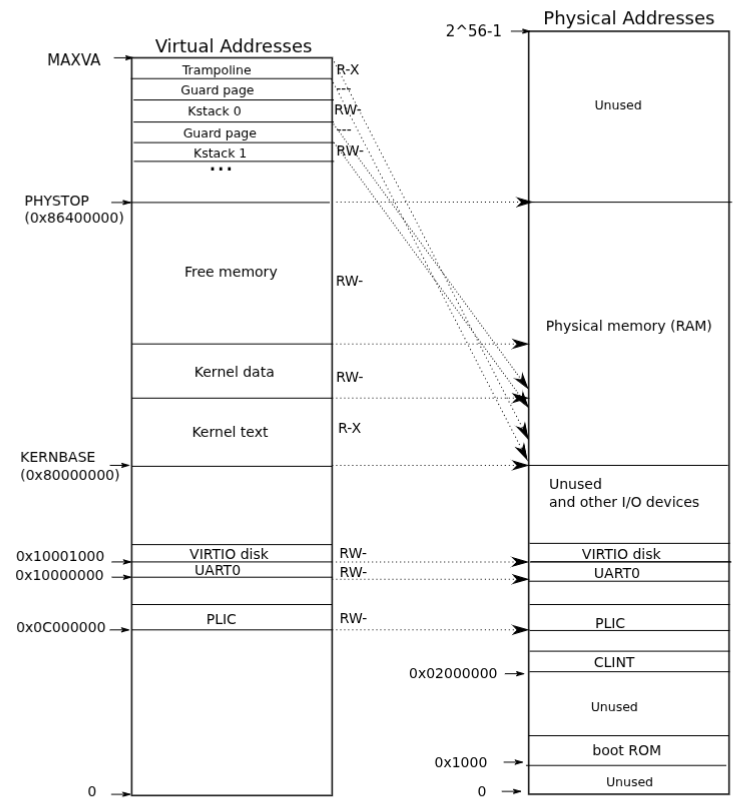
- Most physical memory and device registers are direct-mapped, so kernel virtual addresses equal physical addresses.
- The kernel image starts at
KERNBASE(0x80000000), where QEMU RAM also begins, and xv6 manages RAM up toPHYSTOP. - Memory-mapped device registers sit below
KERNBASEin physical address space. - Direct mapping lets the kernel use physical addresses directly, which simplifies operations such as copying pages during
fork. - The trampoline and kernel stacks are exceptions to the simple direct-map pattern.
- Kernel text and trampoline code are read/execute; kernel data, RAM, and kernel stacks are read/write; guard pages are invalid.
| Virtual | Physical | Pages | Perm | Purpose |
|---|---|---|---|---|
UART0 | UART0 | 1 | R W | Console UART registers |
VIRTIO0 | VIRTIO0 | 1 | R W | Disk MMIO registers |
PLIC range | Same | 0x4000000 / PGSIZE | R W | Interrupt controller |
KERNBASE to etext | Same | (etext - KERNBASE) / PGSIZE | R X | Kernel text |
etext to PHYSTOP | Same | (PHYSTOP - etext) / PGSIZE | R W | Kernel data and RAM |
TRAMPOLINE | trampoline.S | 1 | R X | Trap entry and return |
KSTACK(p) | New page | 1 per process slot | R W | Process kernel stack |
| Stack guard page | Unmapped | 1 per process slot | None | Overflow trap |
TRAMPOLINE
- is not direct-mapped,
- a high virtual address for trap entry and return code,
- mapped in kernel VM so trap code remains reachable while switching between kernel and user page tables.
KSTACK(p)
- gives each process slot a high kernel stack,
- mapped in kernel VM so the kernel has a protected stack during system calls, interrupts, and exceptions,
- a guard page is left unmapped next to each stack, so stack overflow causes a fault instead of overwriting another stack.
The VM layer provides software routines to build page-table trees, install VA-to-PA mappings, remove mappings, free page-table pages, and check whether an address is already mapped.
---
config:
  layout: dagre
---
flowchart LR
  classDef process fill:#F3EFE2,stroke:#111,stroke-width:2px,color:#111
  classDef file fill:#FFFFFF,stroke:#111,stroke-width:3px,color:#111
  classDef source fill:#E9F1FF,stroke:#111,stroke-width:2px,color:#111
  classDef iface fill:#EDE7D4,stroke:#111,stroke-width:2px,color:#111
  classDef backend fill:#F8F8F8,stroke:#111,stroke-width:2px,color:#111
  subgraph BUILD["kernel VM construction: software builds mappings"]
    direction TB
    KVMINIT["kvminit<br/><br/>starts kernel VM setup"]:::iface
    KVMMAKE["kvmmake<br/><br/>allocates root page table<br/>creates kernel mappings"]:::iface
    KVMMAP["kvmmap<br/><br/>kernel wrapper for mapping ranges"]:::iface
    MAPPAGES["mappages<br/><br/>install VA to PA mappings"]:::iface
    WALK["walk<br/><br/>software page-table walk<br/>finds or creates lower-level tables"]:::iface
    MAPSTACKS["proc_mapstacks<br/><br/>maps per-process kernel stacks<br/>leaves guard pages invalid"]:::iface
    KVMHART["kvminithart<br/><br/>sfence.vma<br/>w_satp(MAKE_SATP(kernel_pagetable))<br/>sfence.vma"]:::iface
  end
  subgraph KSTATE["kernel page-table state"]
    direction TB
    KPAGETABLE["kernel_pagetable<br/><br/>shared kernel address space"]:::source
    KPTPAGE["kernel page-table pages<br/><br/>4096-byte pages<br/>512 PTEs each"]:::file
    KPTE["kernel PTEs<br/><br/>PTE_V<br/>PTE_R / PTE_W / PTE_X<br/>normally no PTE_U"]:::file
  end
  subgraph VAMAP["virtual to physical address map"]
    direction TB
    subgraph DIRECT_PAIR["direct map"]
      direction LR
      DIRECTMAP["direct map region<br/><br/>kernel VA = physical address<br/>RAM + device MMIO<br/>permissions split by region"]:::source
      RAM["physical RAM<br/><br/>KERNBASE = 0x80000000<br/>PHYSTOP = KERNBASE + 128MB"]:::source
      MMIO["memory-mapped device registers<br/><br/>UART0<br/>VIRTIO0<br/>PLIC"]:::backend
    end
    subgraph TEXT_PAIR["kernel text map"]
      direction LR
      KTEXT["kernel text<br/><br/>readable + executable<br/>PTE_R | PTE_X"]:::source
      KERNELIMG["kernel image in RAM<br/><br/>entry.S<br/>kernel text<br/>kernel data<br/>end symbol"]:::source
    end
    subgraph DATA_PAIR["kernel data map"]
      direction LR
      KDATA["kernel data + usable RAM<br/><br/>readable + writable<br/>PTE_R | PTE_W"]:::source
      RAMDATA["physical RAM<br/><br/>usable RAM region"]:::source
    end
    subgraph STACK_PAIR["kernel stack map"]
      direction LR
      KSTACKS["kernel stacks<br/><br/>one stack per process<br/>mapped high<br/>invalid guard page below"]:::source
      STACKPAGES["kernel stack physical pages<br/><br/>allocated by kalloc"]:::source
    end
    subgraph TRAMP_PAIR["trampoline map"]
      direction LR
      KTRAMP["TRAMPOLINE<br/><br/>trap entry / return code<br/>same VA in kernel and user page tables"]:::source
      TRAMPPAGE["trampoline physical page<br/><br/>trampoline.S code"]:::file
    end
  end
  subgraph ALLOC["physical page allocator functions"]
    direction TB
    KALLOC["kalloc / kfree<br/><br/>allocate or release 4096-byte physical pages"]:::iface
  end
  subgraph RUNTIME["kernel-mode runtime: hardware uses mappings"]
    direction TB
    KERNELCODE["kernel code<br/><br/>load / store / fetch<br/>using kernel virtual addresses"]:::process
    CPU["RISC-V CPU"]:::process
    SATP["satp CSR<br/><br/>active root page table"]:::source
    TLB["TLB<br/><br/>cached VA to PA translations"]:::backend
    HWALKER["Sv39 hardware page-table walker<br/><br/>walks kernel_pagetable on TLB miss"]:::backend
    ACCESS["physical memory / MMIO access"]:::source
    FAULT["kernel page fault<br/><br/>invalid mapping or bad permission"]:::backend
  end
  KVMINIT --> KVMMAKE
  KVMMAKE -->|"allocates root using"| KALLOC
  KVMMAKE --> KVMMAP
  KVMMAKE --> MAPSTACKS
  KVMMAP --> MAPPAGES
  MAPPAGES --> WALK
  WALK -->|"writes / finds PTEs in"| KPAGETABLE
  WALK -->|"may allocate lower-level tables via"| KALLOC
  KALLOC -->|"returns"| KPTPAGE
  MAPSTACKS -->|"allocates stack pages via"| KALLOC
  MAPSTACKS -->|"uses"| KVMMAP
  KVMHART -->|"loads root into"| SATP
  SATP -->|"selects"| KPAGETABLE
  KPAGETABLE -->|"contains"| KPTPAGE
  KPTPAGE -->|"contains"| KPTE
  KPAGETABLE -->|"describes"| DIRECTMAP
  KPAGETABLE -->|"describes"| KTEXT
  KPAGETABLE -->|"describes"| KDATA
  KPAGETABLE -->|"describes"| KSTACKS
  KPAGETABLE -->|"describes"| KTRAMP
  DIRECTMAP -->|"maps RAM"| RAM
  DIRECTMAP -->|"maps MMIO"| MMIO
  KTEXT -->|"maps"| KERNELIMG
  KDATA -->|"maps"| RAMDATA
  KSTACKS -->|"maps"| STACKPAGES
  KTRAMP -->|"maps"| TRAMPPAGE
  KERNELCODE --> CPU
  CPU -->|"uses"| SATP
  CPU -->|"checks first"| TLB
  TLB -->|"on miss"| HWALKER
  HWALKER -->|"reads"| KPTPAGE
  HWALKER -->|"valid PTE"| ACCESS
  HWALKER -->|"invalid / bad permission"| FAULT
User VM
Each process has an independent page table, giving it a private virtual address space. User memory starts at virtual address zero and grows upward through text, data, stack, and heap regions toward MAXVA.
- The trampoline and trapframe sit at the top of the user address space to support safe user-kernel transitions.
- A guard page below the user stack is made inaccessible so stack overflow becomes a fault instead of silent memory corruption.
- Dynamic memory growth and shrinkage are exposed through
sbrk; the VM layer adjusts mappings and physical backing as needed. - User VM routines create page tables, allocate and remove mappings, copy address spaces during
fork, and clear user access for guard pages. - User/kernel copy helpers validate user pointers through the process page table before copying data across the protection boundary.
- Lazy allocation uses page faults to allocate missing heap pages on demand.
A process’s user address space, with its initial stack:
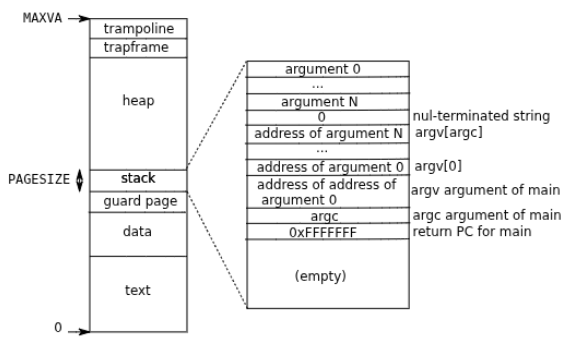
User virtual memory looks contiguous, but physical pages may be scattered anywhere in RAM.
| Virtual region | Physical backing |
|---|---|
| text | Physical RAM pages allocated from the free-memory pool, then filled from the ELF file. |
| data | Physical RAM pages allocated from the free-memory pool. |
| heap | Physical RAM pages allocated from the free-memory pool as the heap grows. |
| stack | Physical RAM pages allocated from the free-memory pool. |
| guard page | No physical page; the mapping is left invalid. |
| trapframe | One per-process physical page allocated from the free-memory pool. |
| trampoline | One shared kernel code page, mapped into every process. |
VA Translation
User VA translation is the runtime path from a process virtual address to a physical page. The active root is selected through satp, and the MMU checks valid, user, and permission bits before allowing a load, store, or instruction fetch.
- Valid leaf PTEs map user virtual pages to physical pages.
- Missing or invalid PTEs may represent lazy heap holes if the address is still below
p->sz. - Failed translation or permission checks raise a user page fault and record the faulting address in
stval. - Lazy allocation handles eligible load/store faults by allocating, zero-filling, and mapping a new physical page.
- Invalid addresses, already-mapped pages, allocation failure, or mapping failure take the fail path.
- Kernel copy helpers validate user pointers through the process page table before copying across the protection boundary.
copyinandcopyoutmay allocate lazy pages;copyinstrrequires the string page to already be mapped.
--- config: layout: dagre --- flowchart LR classDef process fill:#F3EFE2,stroke:#111,stroke-width:2px,color:#111 classDef file fill:#FFFFFF,stroke:#111,stroke-width:3px,color:#111 classDef source fill:#E9F1FF,stroke:#111,stroke-width:2px,color:#111 classDef iface fill:#EDE7D4,stroke:#111,stroke-width:2px,color:#111 classDef backend fill:#F8F8F8,stroke:#111,stroke-width:2px,color:#111 subgraph USTATE["running user VM state"] direction TB UPAGETABLE["p->pagetable<br><br>root of the process's active<br>three-level Sv39 user page table"]:::source UPTE["user PTEs<br><br>valid leaf PTEs map user pages<br>absent or invalid entries may represent<br>lazy holes when the VA is below p->sz"]:::file VAMAP["runtime VA-to-PA map<br><br>text, data, stack, mapped heap pages,<br>and lazy sbrk heap range below p->sz"]:::source end subgraph ACCESSPATH["user access, translation, and lazy fault resolution"] direction TB USERACCESS["user instruction<br><br>load, store, or fetch<br>uses a user virtual address"]:::process MMU["RISC-V address translation<br><br>satp selects p->pagetable<br>TLB may cache the translation<br>Sv39 walker checks PTE bits on miss"]:::backend ACCESSOK["physical access succeeds<br><br>VA translates to PA<br>and requested R / W / X access<br>is allowed"]:::source PAGEFAULT["user page fault<br><br>missing mapping, invalid PTE,<br>or permission failure<br>reported with faulting VA in stval"]:::backend USERTRAP["usertrap<br><br>handles traps from user mode<br>load/store page faults<br>scause 13 or 15 may call vmfault"]:::process VMFAULT["vmfault<br><br>lazy allocator for unmapped VA<br>VA must be below p->sz<br>and not already mapped<br><br>on success, zero-fills the page<br>and installs a user mapping"]:::iface KALLOC["kalloc<br><br>allocates one 4096-byte<br>physical backing page"]:::iface MAP["mappages / walk<br><br>vmfault calls mappages<br>mappages calls walk<br><br>walk may allocate missing<br>page-table pages if needed"]:::iface FAIL["fail path<br><br>user fault kills process<br>kernel copy helper returns -1"]:::process end subgraph COPYPATH["kernel access to user buffers"] direction TB SYSCALL["system call<br><br>kernel receives a user pointer<br>but must translate and validate it<br>through the user page table"]:::process COPYIN["copyin<br><br>copy bytes from user VA<br>to kernel buffer<br>may allocate lazy source page"]:::iface COPYOUT["copyout<br><br>copy bytes from kernel buffer<br>to user VA<br>may allocate lazy destination page"]:::iface COPYINSTR["copyinstr<br><br>copy null-terminated user string<br>requires the string page<br>to already be mapped"]:::iface WALKADDR["walkaddr<br><br>software user VA translation<br>returns PA only if PTE_V<br>and PTE_U are set"]:::iface PAOK["physical address found<br><br>valid user-accessible mapping<br>returned to copy helper"]:::source WRITECHK["copyout write check<br><br>after translation,<br>destination PTE must also<br>have PTE_W set"]:::backend COPYBYTES["copy bytes<br><br>copyin / copyout use memmove<br>copyinstr scans byte-by-byte<br>until NUL or max"]:::process end UPAGETABLE -->|"contains leaf and non-leaf entries"| UPTE UPTE -->|"leaf entries define mapped portions of"| VAMAP USERACCESS -->|"issued while process runs in user mode"| MMU MMU -->|"valid PTE and permission bits allow access"| ACCESSOK MMU -->|"unmapped lazy page or failed permission check"| PAGEFAULT PAGEFAULT -->|"trap switches from user to kernel"| USERTRAP USERTRAP -->|"only load/store page faults are lazy-allocation candidates"| VMFAULT VMFAULT -->|"VA is below p->sz and currently unmapped"| KALLOC KALLOC -->|"returns physical page to vmfault"| VMFAULT VMFAULT -->|"zero-fills page, then installs mapping with"| MAP VMFAULT -->|"VA outside p->sz, already mapped,<br>out of memory, or mapping failure"| FAIL MAP -->|"updates the page-table tree rooted at"| UPAGETABLE SYSCALL --> COPYIN SYSCALL --> COPYOUT SYSCALL --> COPYINSTR COPYIN -->|"translate source user VA"| WALKADDR COPYOUT -->|"translate destination user VA"| WALKADDR COPYINSTR -->|"translate string user VA"| WALKADDR WALKADDR -->|"walks and checks mappings in"| UPAGETABLE WALKADDR -->|"valid PTE_V and PTE_U mapping found"| PAOK WALKADDR -->|"missing page: copyin / copyout ask vmfault to allocate"| VMFAULT WALKADDR -->|"missing page: copyinstr does not allocate"| FAIL PAOK -->|"copyin / copyinstr source PA is available"| COPYBYTES PAOK -->|"copyout destination needs one more check"| WRITECHK WRITECHK -->|"PTE_W set on destination"| COPYBYTES WRITECHK -->|"read-only destination, e.g. text page"| FAIL
VM Construction
User VM is constructed when a process image is created or replaced. xv6 either builds a fresh ELF-backed image for exec, or copies an existing address space for fork.
kexecbuilds a replacement address space from an ELF file.kforkcreates a child address space by copying the parent’s mapped user pages.- Both paths start from a per-process page table with trampoline and trapframe mappings.
- Physical memory comes from
kallocfor user data pages and page-table pages. - The final result is
p->pagetable, a three-level Sv39 user page table with user-accessible leaf mappings and the required permissions.
--- config: layout: dagre --- flowchart LR subgraph KEXECPATH["exec path: replace current VM"] direction TB KEXEC["kexec<br><br>builds a new address space<br>from an ELF file<br>then commits it to p->pagetable"] LOADSEG["loadseg<br><br>copies ELF segment bytes<br>into mapped user pages"] FLAGS2PERM["flags2perm<br><br>translates ELF flags<br>to PTE_X / PTE_W"] end subgraph KFORKPATH["fork path: copy parent VM"] direction TB KFORK["kfork<br><br>allocates child process state<br>then duplicates parent memory"] PROCPGTBL["proc_pagetable<br><br>creates a user page table<br>with trampoline and trapframe<br>kernel-only mappings"] end subgraph COMMON["shared construction helpers"] direction TB UVMCREATE["uvmcreate<br><br>allocates and zeroes<br>an Sv39 root page-table page"] UVMALLOC["uvmalloc<br><br>allocates user pages<br>and maps them with<br>PTE_R | PTE_U | xperm"] UVMCOPY["uvmcopy<br><br>copies mapped parent pages<br>and preserves PTE flags"] MAPPAGES["mappages<br><br>creates leaf PTEs<br>for an aligned VA range"] WALK["walk<br><br>finds or creates PTE slots<br>in the three-level tree"] end subgraph USTATE["process user VM state"] direction TB UPAGETABLE["p->pagetable<br><br>root of the user address space"] UPTPAGE["user page-table pages<br><br>root and lower-level pages"] UPTE["user PTEs<br><br>non-leaf PTEs point downward<br>leaf PTEs encode PA and flags"] end subgraph MAPBOX["virtual-to-physical map"] direction TB VAMAP["resulting user map<br><br>ELF text, data, bss,<br>user stack, guard page,<br>trapframe, trampoline"] end subgraph ALLOC["physical page allocator"] direction TB KALLOC["kalloc / kfree<br><br>allocates or releases<br>one 4096-byte page"] end KEXEC -- "creates fresh page table" --> UVMCREATE KEXEC -- "allocates segment and stack pages" --> UVMALLOC KEXEC -- "copies file-backed bytes" --> LOADSEG KEXEC -- "derives page permissions" --> FLAGS2PERM KFORK -- "gets child page table" --> PROCPGTBL KFORK -- "duplicates mapped parent memory" --> UVMCOPY PROCPGTBL -- "starts from empty root" --> UVMCREATE PROCPGTBL -- "maps trampoline and trapframe without PTE_U" --> MAPPAGES UVMCREATE -- "allocates root page" --> KALLOC UVMCREATE -- "returns root pointer" --> UPAGETABLE UVMALLOC -- "gets zero-filled pages" --> KALLOC UVMALLOC -- "maps each page" --> MAPPAGES UVMCOPY -- "allocates child pages" --> KALLOC UVMCOPY -- "maps copied pages" --> MAPPAGES MAPPAGES -- "uses" --> WALK WALK -- "traverses" --> UPAGETABLE WALK -- "may allocate lower-level pages" --> KALLOC UPAGETABLE -- contains --> UPTPAGE UPTPAGE -- holds --> UPTE UPTE -- "leaf PTEs define" --> VAMAP KALLOC -- "also supplies" --> UPTPAGE KEXEC:::iface LOADSEG:::iface FLAGS2PERM:::iface KFORK:::iface PROCPGTBL:::iface UVMCREATE:::iface UVMALLOC:::iface UVMCOPY:::iface MAPPAGES:::iface WALK:::iface UPAGETABLE:::source UPTPAGE:::file UPTE:::file VAMAP:::source KALLOC:::iface classDef file fill:#FFFFFF,stroke:#111,stroke-width:3px,color:#111 classDef source fill:#E9F1FF,stroke:#111,stroke-width:2px,color:#111 classDef iface fill:#EDE7D4,stroke:#111,stroke-width:2px,color:#111 classDef path fill:#F7F7F7,stroke:#111,stroke-width:2px,color:#111
Heap Allocation
Heap allocation is controlled by the process size boundary and the user page table. An address can be logically valid because it is below p->sz, even if no physical page has been mapped yet.
- Eager growth allocates and maps physical pages immediately.
- Lazy growth increases
p->szonly; the first access to the unmapped range triggers lazy fault handling. - Shrink removes mappings above the new size and frees any physical pages that were actually mapped.
- Missing or invalid PTEs are skipped during shrink because lazy holes have no physical backing.
p->szdefines the legal heap range; the page table records the pages that actually exist.
--- config: layout: dagre --- flowchart LR classDef actual fill:#DFF3E3,stroke:#111,stroke-width:2px,color:#111 classDef logical fill:#FFF2CC,stroke:#111,stroke-width:2px,color:#111 classDef state fill:#E9F1FF,stroke:#111,stroke-width:2px,color:#111 classDef file fill:#FFFFFF,stroke:#111,stroke-width:3px,color:#111 classDef backend fill:#F8F8F8,stroke:#111,stroke-width:2px,color:#111 subgraph HEAPSTATE["heap-related user VM state"] direction TB PROCSZ["p->sz<br><br>declared user memory size<br>and heap validity boundary"]:::state UPAGETABLE["p->pagetable<br><br>user page table edited by<br>heap growth, shrink, and faults"]:::state UPTE["heap PTE state<br><br>valid leaf PTEs map heap pages<br>absent or invalid entries may be<br>lazy holes below p->sz"]:::file VAMAP["heap VA-to-PA state<br><br>mapped heap pages,<br>unmapped lazy heap range,<br>and mappings removed by shrink"]:::state end subgraph SBRKPATH["sbrk heap request"] direction TB SBRK["sys_sbrk(n, t)<br><br>actual function<br>returns old p->sz<br>then chooses eager, lazy,<br>or shrink behavior"]:::actual EAGER["eager growth branch<br><br>logical path<br>SBRK_EAGER with n > 0<br>allocates and maps pages now"]:::logical LAZY["lazy growth branch<br><br>logical path<br>non-eager n >= 0<br>extends p->sz only"]:::logical SHRINK["shrink branch<br><br>logical path<br>n < 0<br>removes mappings above<br>the new heap size"]:::logical FAULTREF["first access to lazy hole<br><br>logical continuation<br>later load/store fault is handled<br>by lazy fault resolution"]:::backend end subgraph VMHELPERS["heap VM helper functions"] direction TB GROWPROC["growproc<br><br>actual function<br>handles eager growth<br>and all shrinking<br>n == 0 is a no-op"]:::actual UVMALLOC["uvmalloc<br><br>actual function<br>allocates zeroed heap pages<br>and maps them with<br>PTE_R, PTE_U, and PTE_W"]:::actual UVMDEALLOC["uvmdealloc<br><br>actual function<br>reduces user memory size<br>and unmaps pages if needed"]:::actual UVMUNMAP["uvmunmap<br><br>actual function<br>removes existing mappings<br>skips missing or invalid PTEs<br>optionally frees pages"]:::actual MAP["mappages / walk<br><br>actual function group<br>mappages installs leaf PTEs<br>walk finds or creates PTE slots<br>and may allocate page-table pages"]:::actual end subgraph ALLOC["physical page allocator functions"] direction TB KALLOC["kalloc<br><br>actual function<br>allocates one 4096-byte<br>physical page"]:::actual KFREE["kfree<br><br>actual function<br>returns a mapped heap page<br>to the allocator"]:::actual end UPAGETABLE -->|"contains heap-related leaf and non-leaf entries"| UPTE UPTE -->|"leaf entries define mapped heap pages in"| VAMAP PROCSZ -->|"bounds valid eager and lazy heap addresses"| VAMAP SBRK -->|"t == SBRK_EAGER or n < 0"| GROWPROC SBRK -->|"t != SBRK_EAGER and n >= 0"| LAZY GROWPROC -->|"n > 0"| EAGER GROWPROC -->|"n < 0"| SHRINK GROWPROC -->|"on success, records final size in"| PROCSZ EAGER -->|"calls"| UVMALLOC UVMALLOC -->|"requests physical heap pages from"| KALLOC KALLOC -->|"returns page to caller"| UVMALLOC UVMALLOC -->|"installs heap mappings with"| MAP MAP -->|"updates page-table tree rooted at"| UPAGETABLE MAP -->|"adds immediate heap VA-to-PA mappings to"| VAMAP LAZY -->|"after overflow and TRAPFRAME checks,<br>updates only"| PROCSZ VAMAP -->|"later user load/store to<br>valid but unmapped heap VA causes"| FAULTREF SHRINK -->|"calls"| UVMDEALLOC UVMDEALLOC -->|"uses when mapped pages must be removed"| UVMUNMAP UVMUNMAP -->|"walks existing mappings in"| UPAGETABLE UVMUNMAP -->|"removes mapped heap pages<br>and skips lazy holes"| VAMAP UVMUNMAP -->|"do_free = 1 frees old backing pages through"| KFREE SHRINK -->|"sets p->sz to deallocated size"| PROCSZ
VM Cleanup
VM cleanup destroys an old user address space by editing and freeing the page-table tree rooted at the old p->pagetable. The VA-to-PA map is only the result of that tree.
execfrees the old address space only after the new image has been installed successfully.- Process destruction frees the trapframe page separately, then frees the old user page table if one exists.
- Special trampoline and trapframe mappings are removed without freeing their physical pages here.
- Normal user mappings are removed across the old
p->szrange. - Mapped text, data, heap, and stack pages are returned to the allocator.
- Missing or invalid PTEs, including lazy holes, are skipped.
- After all leaf mappings are gone, the remaining Sv39 page-table pages are freed recursively.
--- config: layout: dagre --- flowchart LR subgraph OLDSTATE["old process VM state"] direction TB PAGETABLE["old p->pagetable<br><br>user page table being destroyed<br>all cleanup works through this tree"] USERMAP["old user VA-to-PA map<br><br>conceptual result of the page table:<br>text, data, heap, stack,<br>TRAPFRAME, and TRAMPOLINE"] end subgraph ENTRY["cleanup entry paths"] direction TB EXECREPLACE["exec replacement<br><br>logical path<br>new image replaces old image"] FREEPROC["freeproc<br><br>actual function<br>destroys process state<br>and frees p->trapframe separately"] PROCFREE["proc_freepagetable<br><br>actual function<br>main per-process VM cleanup"] SPECIAL["uvmunmap special mappings<br><br>removes TRAMPOLINE and TRAPFRAME PTEs<br>with do_free = 0<br><br>does not free trampoline code<br>does not free trapframe page here"] UVMFREE["uvmfree<br><br>frees normal user memory first<br>then frees the page-table tree"] UVMUNMAP["uvmunmap normal mappings<br><br>removes text, data, heap, and stack PTEs<br>with do_free = 1<br><br>frees mapped user physical pages<br>skips missing or invalid PTEs"] FREEWALK["freewalk<br><br>recursively frees Sv39 page-table pages<br>after all leaf mappings are gone"] KFREE["kfree<br><br>returns freed physical pages<br>to the allocator"] end PAGETABLE -- defines --> USERMAP EXECREPLACE -- after new image is installed,<br>free old address space --> PROCFREE FREEPROC -- "if p->pagetable exists" --> PROCFREE FREEPROC -- "frees p->trapframe separately with" --> KFREE PROCFREE -- first remove special mappings --> SPECIAL SPECIAL -- edits special PTEs in --> PAGETABLE PROCFREE -- then free normal user VM --> UVMFREE UVMFREE -- unmap user memory range --> UVMUNMAP UVMUNMAP -- walks and clears leaf PTEs in --> PAGETABLE UVMUNMAP -- frees mapped user pages through --> KFREE UVMFREE -- after leaf mappings are gone --> FREEWALK FREEWALK -- "walks and frees page-table tree rooted at" --> PAGETABLE FREEWALK -- "frees page-table pages through" --> KFREE PAGETABLE:::state USERMAP:::state EXECREPLACE:::logical FREEPROC:::actual PROCFREE:::actual SPECIAL:::actual UVMFREE:::actual UVMUNMAP:::actual FREEWALK:::actual KFREE:::actual classDef actual fill:#DFF3E3,stroke:#111,stroke-width:2px,color:#111 classDef logical fill:#FFF2CC,stroke:#111,stroke-width:2px,color:#111 classDef state fill:#E9F1FF,stroke:#111,stroke-width:2px,color:#111