Here we will examine the data link protocols found on point-to-point lines in the Internet in two common situations. The first situation is when packets are sent over SONET optical fiber links in wide-area networks. These links are widely used, for example, to connect routers in the different locations of an ISP’s network. The second situation is for ADSL links running on the local loop of the telephone network at the edge of the Internet. These links connect millions of individuals and businesses to the Internet.
SONET is the physical layer protocol that is most commonly used over the wide-area optical fiber links that make up the backbone of communications networks, including the telephone system. To carry packets across these links, some framing mechanism is needed to distinguish occasional packets from the continuous bitstream in which they are transported. PPP runs on IP routers to provide this mechanism.
Provides three main features:
- A framing method that unambiguously delineates the end of one frame and the start of the next one. The frame format also handles error detection.
- A link control protocol for bringing lines up, testing them, negotiating options, and bringing them down again gracefully when they are no longer needed.
- A way to negotiate network-layer options in a way that is independent of the network layer protocol to be used. The method chosen is to have a different NCP (Network Control Protocol) for each network layer supported.
The PPP frame format was chosen to closely resemble the frame format of HDLC (High-level Data Link Control), a widely used instance of an earlier family of protocols, since there was no need to reinvent the wheel.
The primary difference between PPP and HDLC is that PPP is byte oriented rather than bit oriented. In particular, PPP uses byte stuffing and all frames are an integral number of bytes. HDLC uses bit stuffing and allows frames of, say, 30.25 bytes.
There is a second major difference in practice, however. HDLC provides reliable transmission with a sliding window, acknowledgements, and timeouts in the manner we have studied. PPP can also provide reliable transmission in noisy environments, such as wireless networks; the exact details are defined in RFC 1663. However, this is rarely done in practice.
| Flag | Address | Control | Protocol | Payload | Checksum | Flag |
|---|---|---|---|---|---|---|
| 0x7E | 0xFF | 00000011 | 1 or 2 | Variable | 2 or 4 | 0x7E |
Address field indicate that all stations are to accept the frame, Default value of Control field indicates an unnumbered frame, LCP provides mechanism for two parties to negotiate to omit these bytes, Protocol field tells what kind of packet is in the Payload field, Length of Payload negotiated using LCP, PPP payload scrambled before inserted into the SONET payload, SONET required frequent bit transitions for synchronization,
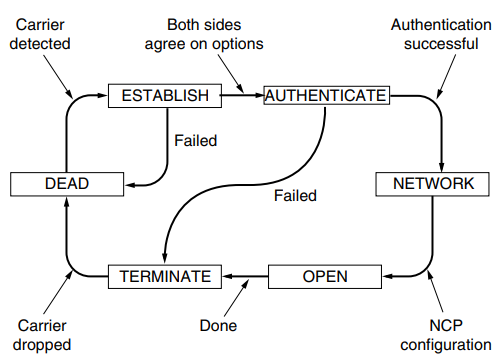
Phases of PPP link configuration starts at DEAD state: