An organization refers to an structure and purpose-driven entity, composed of individuals who collaborate to achieve specific goals and objectives.
It is a social structure that involves coordination of man, machine and materials in a systematic manner to accomplish a common mission.
Organization can vary widely in size, scope, and nature, encompassing everything from small community groups to large multinational corporations, non-profit organizations, government agencies, and more.
Organization an be viewed as a complex system that incorporates elements from various perspectives, including goal-oriented, social and technological aspects:
Necessity:
Organizations are necessary for a multitude of reasons due to their pivotal role in shaping various aspects of society, economy and human interaction:
-
Coordination and collaboration: Organization provide a structured framework for individual to work together towards a shared goals, they facilitate the coordination of efforts, ensuing tasks are completed efficiently. This enhances productivity and minimizes duplication of efforts.
-
Specialization: Organization enable individuals to specialize in specific roles and tasks, leading to increased efficiency and expertise, division of labor constitutes to higher-quality outcomes. This specialization allows individuals to focus on what they do best, leading to higher efficiency and quality in their work. It also promotes the development of expertise within the organization
-
Efficient resource allocation: Organizations help in the efficient allocation of resources, including human, financial, and physical resources. Through proper planning and resource allocation, an organization can optimize its operations, reduce wastage and ensure that resources are used effectively to achieve its objectives.
-
Economic contribution: Businesses and corporations drive economic growth by creating jobs, generating revenue, and producing goods and services that fulfill societal needs.
-
Innovation and progress: Organizations often serve as hubs for innovation and progress. They encourage employees to come up with new ideas, invest in research and development, and adapt to changing market conditions. This culture of innovation can lead to the development of new products, services, and technologies that benefit society.
-
Problem solving: Organizations provide a structured framework for identifying and solving problems. They have processes in place to address challenges and make decisions. This systematic approach to problem-solving ensures that issues are addressed in a timely and effective manner, minimizing disruptions to the organization’s operations.
-
Governance and order: Organizations establish rules, policies, and procedures to maintain order and ensure that activities are conducted ethically and in accordance with legal requirements. Effective governance within an organization promotes transparency, accountability, and responsible behavior.
-
Importance in society:
Play a pivotal role in society and have several crucial functions:
-
Economic contribution:
-
Social services: Non-profit organizations,
-
Innovation:
-
Education and skill development:
-
Research and development:
-
Social interaction and networking:
Formal versus informal organizations:
An organization is a basic social unit that has been established for the purpose of achieving a goal, a formal organization is characterized by several distinct features:
- a common goal; an accepted pattern of purpose.
- a set of shared values or common beliefs that give individuals a sense of identification and belonging.
- continuity of goal-oriented interaction.
- a division of labor deliberately planned to achieve a goal.
- a system of boundary or a chain of command to achieve conscious integration of the group and conscious coordination of efforts to reach the goal.
An informal organization may be characterized by some of the features of formal organizations, but it lacks one or more of these features.
Formal organizations almost inevitably give rise to informal organizations, such informal groups may be viewed as spontaneous organizations that emerge because individuals are brought together in a common workplace to purse a common goal, which makes social interaction inescapable.
Languages, cultures, preferences, attitudes, tastes or other factors.
Not necessarily formed to accomplish the organization goals, rather to fulfill the social needs.
Informal organizations arise as a means of easing the restrictions of formal structures, as in the cooperative communication and coordination that may occur outside of the officially mandated channels of authority.
Systems Approach
The system approach is based on the generalization that an organisation is a system and its components are inter-related and inter-dependent.
A system is composed of related and dependent elements which, when in iteractions, form a unitary whole
It is simply an assemblage or combination of things or parts, forming a complex whole. Its important feature is that is is composed of hierarchy of sub-systems.
An organisation as a system has the following characteristics:
- A system is goal-oriented
- A system consists of several sub-systems which are interdependent and inter-related
- A system is engaged in processing or transformation of inputs into outputs
- An organization is an open and dynamic system, it has continuous interface with the external environment as it gets inputs from the environment ad supplies its output to the environment
- It is sensitive to its environment such as government policies, competition int he market, technological advancement, tastes of people etc.
Features of systems approach:
-
Interdependent sub-systems: All sub-systems are functionally interacting and interdependent, are used together into an organic whole through goals, authority flows, resources flows and so on.
-
Whole organisation: The system approach provides a unified focus to organisational efforts, it gives managers a way of looking at the organisation as a whole that is greater than the sum of its parts. The stress is laid on integration of various sub-systems of the organisation to ensure overall effectiveness of the system
-
Synergy: The output of a system is always more than the combined output of its parts, this is called the law of synergy. The parts of system become more productive when they interact with each other than when they act in isolation.
-
Multi-disciplinary: Modern theory of management is enriched by contributions from various disciplines like psychology, sociology, economics, anthropology, mathematics, operations research and so on.
-
Goal-oriented system: Organizations are fundamentally goal-oriented systems. They exist to achieve specific objectives or outcomes. These goals could be related to profitability, market share, social impact, research and development, or any other purpose that the organization is designed to fulfill. The goals provide a sense of direction and purpose to the organization, guiding its activities and decisions.
-
Social System: Organizations are comprised of people who work together within a structured framework. This social aspect of organizations is crucial, as it involves the interactions, relationships, and communication among individuals within the organization. People collaborate, share knowledge, and contribute their unique skills and perspectives to achieve the organization’s goals. The social system within an organization shapes its culture, values, and the way people interact with each other.
-
Technological System: In today’s world, technology plays a significant role within organizations. This technological system encompasses the knowledge, tools, and techniques that employees use to perform their tasks efficiently and effectively. It includes hardware, software, data systems, and the integration of technology into various aspects of the organization’s operations. Technological advancements can improve productivity, streamline processes, and facilitate innovation within the organization.
Management
Management is the process of planning and directing of effort and the organizing and employing of resources, both human and material, to accomplish some predetermined objective (within an organization).
Fundamentally about achieving goals and objectives through the coordinated efforts of individuals within an organization. It involves not only the tasks themselves but also the people who perform them.
The practical execution of the plans and decisions on a day-to-day basis requires administrative activities that managers may assign to executive officers or administrative.
Managers are responsible for overseeing the practical execution of plans and decisions on a day-to-day basis. They may delegate administrative activities to executive officers or administrative staff, but they maintain overall responsibility for ensuring that things run smoothly.
The many variables associated with the human element make management as much of an art as a science, even with complex analytical tools for decision making such as probability studies, stochastic simulation, and similar mathematical elements, the manager must rely on intuition and experience in assessing such factors as timing and tactics for persuasion.
Management is a technique of extracting work from others in an integrated and co-ordinated manner for realising the specific objectives through productive use of material resources.
Importance of management:
Management is indispensable for the successful functioning of every organization, it is all the more important in business enterprises.
No business runs in itself, even on momentum, every business needs repeated stimulus which can only be provided by management.
Management is a dynamic live-giving element in an organization, without it the resources of production remain mere resources and never become production.
-
Achievement of group goals: A human group consists of several persons, each specializing in doing a part of the total task. Each person may be working efficiently, but the group as a whole cannot realize its objectives unless there is mutual cooperation and coordination among the members of the group. Management creates team-work and coordination in the group.
-
Optimum utilization of resources: Managers forecast the need for materials, machinery, money and manpower, they ensure that the organization has adequate resources and at the same time does not have idle resources.
-
Minimization of cost: In the modern era of cut-throat competition no business can succeed unless it is able to supply the required goods and services at the lowest possible cost per unit, management directs day-to-day operations in such a manner that all wastage and extravagance are avoided.
-
Survival and growth: Modern business operates in a rapidly changing environment, an enterprise has to adapt itself to the changing demands of the market and society, management keeps in touch with the existing business environment and draws its predictions about the trends in future.
-
Generation of employment: By setting up and expanding business enterprises, managers create jos for the people.
-
Development of nation: Management is most crucial factor in economic and social development, the development of a country largely depends on the quality of the management and coordination among the members of the group
Classic management functions:
- planning - the selection of objectives, the establishment of goals, and the factual determination of the existing situation and the desired future state
- organizing - the design of pattern of roles and relationships that contribute to the goal, roles are assigned, authority and responsibility are determined, and provision is made for coordination, organizing typically involves the development of the organization chart, job descriptions, and statements of work flow
- directing - the provision of guidance and leadership so that the work performed is goal-oriented, it is the exercise of the manager’s influence, the process of teaching, coaching, and motivating others
- coordination - harmonization and synchronization of various activities, tasks, and resources within an organization to ensure that they work together efficiently and effectively towards shared goal
- controlling - the determination of what is being accomplished, the assessment of performance as it relates to the accomplishment of the organizational goals, and the initiation of corrective actions, in contemporary management practice, the larger concepts of performance improvement and total quality management include controlling
At different phases in the life of the organization, one or another management function may be dominant, in early stages of organizational development, for example, planning is the manager’s primary function, when the organization is mature, however, controlling functions are emphasized.
Level of management:
- Top level management:
- Higher authority includes board of directors, chairperson, MD and general managers of functional areas like production, marketing, finance, and human resource management.
- Sets the goals, objectives, policies, and budgeting of the organization.
- Main functions involve decision making.
- Prime concerns include enhancing shareholder values, providing vision and mission to organisation, upholding overall objectives of the organization, taking policy decision, review of budget and keeping organisation financially sound, maintaining progress, profit, and sustainability of organisation.
- Sets the rules and regulations, issues order to the lower levels, guidelines and instructions.
- Middle level management:
- Head of the functional departments.
- Mediator between the top level management and the lower level.
- Main function is to implement the policies set by the top level.
- Functions include creating coordination and corporation among various departments of the organisation to design and operate upon a system in the organisation which would keep various resources in smooth flow as well as would ensure motivation and morale of proper working in the organisation.
- Lower level management:
- Responsible for the day to day activities.
- Supervision of the workers and labors.
- More involved in working to achieve goals set by the organization.
- There is more requirement of technical skills than conceptual skills or human skills, directly connected to the people who work at operational level.
- Concerned with direction and control of activities than planning and organizing functions.
Skills of the manager:
A manager’s functions can be considered a circle of actions in which each component leads to the next, although the functions can be identified as separate sets of actions for purpose of analysis, the manager in actual practice carries out these activities in complex, unified manner within the total process of managing.
Other individuals in the organization carry out some of these activities, either periodically or routinely, but the manager is assigned these specific activities in their entirety, as a continuing set of functions.
Traditional functions of a manager were identified based on earlier work of Henri Fayol.
-
Conceptual skill:
- Is the ability of see big picture, to recognize significant elements in a situation and to understand the relationships among the elements
- Requires having the ability of visualize the enterprise as a whole, to envision all the functions involved in a given situation or circumstance, to understand how its par depend on one another and anticipate how to change in any of its parts will affect the whole
- Suggesting a new product line for a company, introducing computer tech to organization etc.
-
Diagnostic and analytical skills:
- Refers to the ability to visualize the best response to a situation
- Analytical means the ability to identify the key variables in a situation, helps them to identify possible approaches to a situation.
-
Technical skill:
- Knowledge and proficiency in activities involving methods, processes, and procedures thus involves working with tools and specific techniques
- For ex, mechanics work with tools, and their supervisors should have the ability to access or guide them on using these tools.
-
Interpersonal and communication skills:
- The manager must be able to convey ideas and information to others and receive information and ideas from others effectively
- Most of the time, a manager’s job is to interact with people inside and outside of the organization
- A manager requires having an effective interpersonal communication skill to keep the responsibilities given to them
-
Decision making skill:
- A manager’s job is to make decision that will lead the organization to the attainment of goals
- Decision making is the skill that makes manager able to recognize opportunities and threat and then select an appropriate course of action to tackle them efficiently so that the organization can benefit them
- A good manager develops decision making skill through training or education and also by learning from bad ones
Models of management:
- Hierarchical management model
- Allocation management model
- Task oriented management model
- Team effort management model
- Knowledge oriented management model
- Goal concentrated management model
History of management:
Knowledge of the history of management provides a framework within which contemporary managerial problems may be reviewed, modern managers benefit from the experiences of their predecessors.
Fayol’s Administrative Management Approach:
The advocates of this school perceive management as a process involving certain functions such as planning, organising, directing and controlling, which is why it is also called functional approach.
Henry Fayol defined management in terms of certain functions and then laid down principles of management which according to him have universal applicability.
The process of management as an ongoing managerial cycle involving planning, organizing, directing, coordination, and controlling, is actually based on the analysis of general management by Fayol.
-
Division of work: Division of work or specialization alone can give maximum productivity and efficiency, both technical and managerial activities can be performed in the best manner only through division of labour and specialization.
-
Authority and responsibility: The right to give order is called authority. The obligation to accomplish is called responsibility. Authority and responsibility are the two sides of the management coin, they exist together, are complementary and mutually dependent.
-
Discipline: The objectives, rules and regulations, the policies and procedure must be honored by each member of an organisation. There must be clear and fair agreement on the rules and objectives, on the policies and procedures. There must be penalties or punishment for non-obedience or indisciple, no organization can work smoothly without discipline - preferably voluntary discipline.
-
Unity of command: In order to avoid any possible confusion and conflict, each member of an organisation must received orders and instructions only from superior.
-
Unity of direction: All members of an organisation must work together to accomplish common objectives
-
Subordination of personal interest to common interest: Called principle of co-operation, each shall work for all and all for each. General or common interest must be supreme in any joint enterprise
-
Remuneration: Fair pay with non-financial rewards can act as the best incentive or motivator for good performance.
-
Centralization and decentralization: There must be a good balance between centralization and decentralization of authority and power, extreme centralization and decentralization must be avoidied.
-
Scalar chain: The unity of command brings about a chain or hierarchy of command linking all members of the organisation from the top to the bottom.
-
Order: There must be a well-defined rules and standards for the work environment and work responsibilities. A safe and orderly environment leads to great coordination.
-
Equity: The organization must be run based upon principles of fairness. Employees should be treated with a combination of kindliness and justice.
-
Stability of tenure: Organizations need low turnover. This allows employees time to learn their jobs, develop skills, and acquire loyalty.
-
Initiative: Managers must promote initiative by allowing employees to create plans and carry them out.
-
Esprit de Corps: Establishing a sense of belonging within the organization creates a sense of unity and moral.
Taylor’s Scientific Management
The momentum for the scientific management approach came from the first industrial revolution, because it brought about such an extraordinary mechanization of industry, this revolution necessitated the development of new management principles and practices.
The work of Frederick Taylor (1865 - 1915) is the commonly accepted basis of scientific management. Scientific management means application of scientific methods to the problems of management. Taylor advocated scientific task setting based on
- time and motion study,
- standardization of materials,
- uniformity of work methods and the assembly line,
- scientific selection and training of workers,
Personal experience at the Bethlehem steel company.
It became famous as a result of a famous case on railroad rate structures heard by the Interstate Commerce Commission.
The basic idea behind the principles of scientific management is to change the mental attitudes of the workers and the management towards each other. Taylor called it ‘Mental Revolution’. Taylor indicated and believed that the relationship between the workers and management should be cordial and completely harmonious. Taylor advocated for a piece-rate system of compensation where workers were paid based on the quantity of work they produced. The system aimed to motivate employees to maximize their output.
Taylor believed that even a small activity like loading paper sheets into boxcars can be planned scientifically. This will save time and also human energy.
Emphasis on following principles:
- Science, not rule of thumb.
- All out efforts for increase in production;
- Work study to simplify work and increase efficiency. This involves methods study, time study and motion study. The goal is to optimize resources, reduce waste, and enhance overall workflow.
- Time study: Time study is a method used in work study to measure the time it takes for a worker to complete a specific task or operation. It involves recording and analyzing each element of the work process to determine the standard time required for the task.
- Motion study: Motion study is a component of work study that focuses on analyzing and optimizing the physical movements and actions of workers while performing tasks. It aims to eliminate unnecessary motions, minimize fatigue, and improve ergonomic conditions. Motion study often involves time and motion analysis to determine the most efficient way to complete a task.
- Find the best methods of doing various jobs and introduce standardized materials, tools and equipment.
- Methodical way to observe progress and standards of output
- Scientific selection and training of workers.
- Almost equal division of work and responsibility between workers and managers.
- Differential piece-wage plan to reward the highly efficient workers.
Before Taylor’s experiment, in a group of 75 labors, average output was 12.7 tons per labor, while after study, rose to 48.8 tons. Daily pay rose from 1.14.
Criticism:
- Concentrates too much on the technical aspects of the work and undermines the human factor in industry.
- Ignores social and psychological needs of workers as it treats them as extension of machines devoid of any feelings and emotions.
- Trade unionists regard it as the means to exploit labor because the wages of the workers were not increased in direct proportion to productivity increases.
The Behaviorists and the Human Relations
Lilian Gilbreth, was a psychologist and tended to stress the needs of the employee, who brought the appreciation of human element into management theory. This approach shifted the focus from mechanistic views of workers to understanding and addressing human behavior and social dynamics within organizations.
Unlike adherents of the scientific management approach, who considered the worker only secondarily, behaviorists focused primarily on the worker.
The application of the behavior sciences to worker productivity and interaction was exemplified in the Hawthorne Experiments conducted by Elton Mayo.
The tenets:
- Social avnd psychological factors: Social and physiological factors, such as group norms, peer pressure, and interpersonal relationship, had a significant impact on worker productivity.
- Human needs: The Behavioral Approach recognized that employees have social and psychological needs in addition to economic needs. These needs include the need for recognition, belongingness, and a sense of purpose.
- Informal groups: Mayo emphasized the importance of informal workgroups and their influence on employee behavior and performance. He argued that these groups often provided emotional support and influenced workers’ attitudes and actions.
- Communication: Effective communication and feedback were seen as crucial elements in understanding and addressing employee needs and concerns. Open channels of communication between management and workers were encouraged.
- Participation and involvement: The Behavioral Approach advocated for involving employees in decision-making and problem-solving processes. It believed that participation increased employee commitment and job satisfaction.
- Leadership styles: Mayo’s work contributed to the study of leadership styles, with an emphasis on the role of supervisors and managers in creating a positive work environment.
- Management must aim at developing social and leadership skill in addition to technical skills, it must take interest in the welfare of workers. Morale and productivity go hand in hand in an organisation.
In summary, the Behavioral and Human Relations Approach, as developed by Elton Mayo, recognized the significance of social and psychological factors in the workplace. It emphasized the importance of understanding and addressing the needs and behaviors of employees to improve productivity, job satisfaction, and organizational performance. Mayo’s work marked a significant shift in management thinking toward a more people-centered approach.
Forms or organizations
-
Sole proprietorship:
- Form of business organisation refers to a business enterprise exclusively owned, managed and controlled by a single person with all authority, responsibility and risk.
- Has a single owner who starts the business by bringing all the resources.
- The controlling power of the sole business always remains with the owner.
- Formation and operation of sole proprietorship form of business organisation does not involve legal formalities, thus, formation is quite easy and simple
Merits:
- Full control: Complete control of the entire business, allowing for a quick decision-making process and full freedom to do business according to their wishes.
- No legal formalities: Legal technicalities are minimum to the extent that there is no law which requires the business to publish its financial accounts or nay other such documents to any members of the public
- Maximum benefits: The owner derives the maximum incentive from the business, does not have to share any of his profits, so work he puts is completely reciprocated in incentives
- No unnecessary procedures: Not many people are involved and thus it cuts out the procedures of hierarchy generally present in a company.
- Easy to form and control:
- Direct motivation:
- Business secrecy:
- Flexibility in operation:
- Personal relation with customer and employees
- Limited government control:
Limitations:
- Limited resources: Being the single owner is not always possible to arrange sufficient funds from his own sources, again borrowing funds from friends and relatives or from banks has its own implications
- Lack of continuity: Linked with life of the proprietor, illness death or insolvency of the properitaor can lead to closure
- Unlimited liability: Owner assumes all debts, in any case of failure of the business, the owner will be required to sell off the property, business as well as personal ones to pay off hte debts
- Limited managerial expertise: Always suffers from lack of managerial expertise, a single person may not be an expert in all fields like purchasing, selling, financing etc.
- Not suitable for large scale operations:
- Health issues/time management:
-
Partnership firm:
- A form of business organization in which two or more persons join together to undertake some form of business activity and share the profits of a business which they run together.
- The persons who own the partnerships business are individually called partners and collectively they are called as firm or partnership firm.
- There is an agreement between partners called the deed to share profits earned and losses incurred in partnership business.
- A partnership business solely rests on utmost good faith and trust among the partners.
- No partner can transfer his share to any outside person wihtout seeking the cosnet of all other partners.
Merits:
- Easy formation: Relatively form as legal formalities are minimal
- More capital available: More than one person provide funds to the enterprise, also incareses borrowing capacity of the firm
- Combined talent, judgement and skill: All partners are involve din decision making, usually are pooled from different specialized areas to complement each other.
- Flexibility: Can easily appreciate and quickly react to the changing condition.
Limitations:
- Unlimited liability: The partners’ personal assets may be at risk if the business cannot pay its debts
- Lack of continuity: Death or withdrawal of one partner comes the partnership to come to an end, betrayal also there so remains uncertainly in continuity of partnership
- Divided authority: There are chances of conflicts among the partners, disagreements between the partners over enterprise matters have destroyed many a partnership
- Risk of implied authority: At times, an incompetent partner may lend the firm into difficulties by taking wrong decision, risk involved in decision taken by one partner is to be broned by other partners also
-
Joint stock company:
- Is a voluntary association of persons having a separate legal existence perpetual succession and common seal.
- Its capital divided into transferable shares
- Also known as corporations or limited companies
- Created by law and it is a distinct legal entity independent of its members, can own property, enter into contracts, can file suits in its own name
- Death, insolvency and insanity or change of members has no effect on the life of a company, can come to an end though the prescribed legal procedure
- Has an seal or official signature of the company and it is affixed on all important documents of company
- Management of company is in hands of elected representatives of stakeholders known indivudally as director and collectively as board of directors
Merits:
- Limited liability: Reduces the degree of risk borne. Shareholders are responsible for the debts of a company only to the extent of the nominal value of their shares.
- Transfer of interest: Easy transfer-ability of shares increases the attrativeness of shares for investment.
- Scope for expansion: A company can collect huge amount of capital from unlimited number of members who are ready to invest because of limited liability, easy transferability and chances of high return
- Professional management: A company can afford to employ highly qualified experts in different areas of business management
Limitations:
- Legal formalities
- Delay in decision making
- Lack of motivation
- Lack of secrecy
Divisional organizations
Division of labors as well as the patterns of coordination, communication, workflow and formal power.
Represents the hierarchical arrangement of various positions in an organization. In simple words it defines who is to direct to whom and who is to report to whom.
-
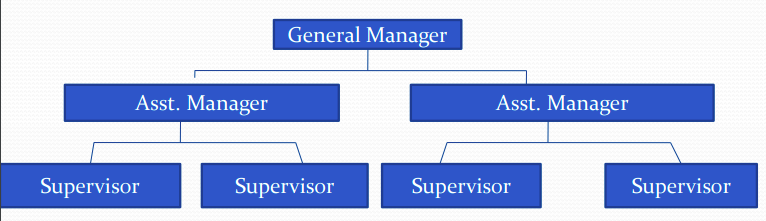
Line organization:
- Simplest and oldest form of organisation structure, called as military or departmental or scalar type of organization.
- Under this system, authority flows directly and vertically from the top of the managerial hierarchy down to different levels of managers and subordinates and down to operative level of workers
- Clearly identifies authority, responsibility and accountability at each level
Advantages:
- Very simple to understand and simple to operate
- Clear cut identification of authority and responsibility
- Communication is fast and easy and feedback can be acted upon faster
- Responsibility is fixed and unified at each level and authority and accountability are clear-cut, hence each individual knows to whom he is responsible and hwo is or in turth responsible to him
- It provides the greater control and discipline in the organization
- People in line type of organization get to know each other better and tend to feel close to each other
- Since each level is defined with specific authority level, prompt decision making is possible
Disadvantages:
- Since the authority is concentrated at top, if they are not able to perform well, the organization will not be successful
- Rigid and inflexible form of organization
- Tendency to become dictatorial
- Overloads the executive with pressing activities so that long-range planning and policy formulation are often neglected
- No provision for specialists and specialization, which is essential for growth and optimizations
- Likely to encourage nepotism
-
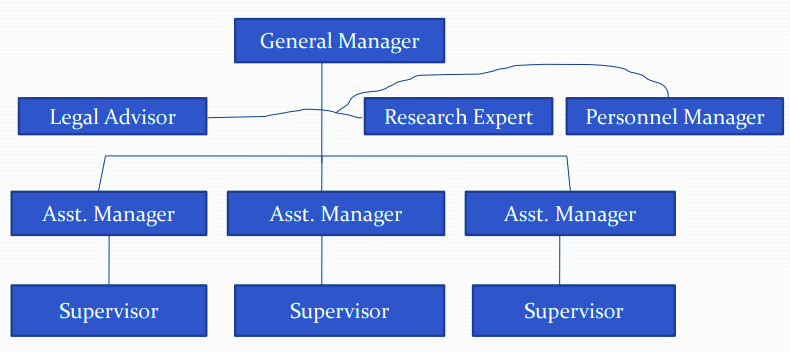
Line and staff organization:
- Line authority moves down in the same manner as in the line organization, with addition of specialists attached to the lines managers to advise and aid them on business matters
- Line functions are those which have direct responsibility for accomplishing the objectives of the enterprises and staff refers to those elements of the organization that help the line to work most effectively in accomplishing the primary objectives of the enterprises.
- These specialist stand ready with their speciality to serve when they are called for, with information for the better performance of the organization
- These staffs do not have any authority or command over the organization
Advantages:
- Line officers can concentrate mainly on the doing function as the work of planning and investigation is performed by the staff
- Staffs can supply complete factual data to the line officers covering activity within and without their own units
- Is more flexible, helpful when organization grows, share the stressful duties and functions of top executives
Disadvantages:
- Confusion and conflict may arise between line and staff, because the allocation of authority and responsibility is not clear and members of the lower levels may be confused by various line orders and staff advice.
- Staff generally advise to the lines, but line decides and acts, therefore staff feel powerless
- Since staff specialists demand higher payments, it is expensive.
- Since staff executives are not accounted for the results, they may not be performing their duties well
-
Functional organization:
- Organizations are divided into several units based on functions such as production, marketing, finance, personnel management and are put under the charge of different persons.
- If a person performs several functions he/she will be under direct charge of the several persons in charge of particular functional units.
- This form encourages the specialization of labor and thus increases efficiency of the organization.
Advantages:
- Specialization of work, every functional incharge is an expert in his/her area and can help the subordinates in better performance in his area.
- A functional manager is required to have expertise in one function only, makes it easy to develop executives
- Reduces the burden on top executives
Disadvantages:
- Sometimes structure can be too complicated for the employees to understand, workers are supervised by a number of bosses
- Violates the principle of unity of command
- A functional manager may tend to think in terms of his own department only rather than the organization as a whole
- Delay in decision making when the decision requires the development of more than one specialists.
-
Committee organization:
Purchasing management:
Purchase management, often referred to as procurement management or procurement, is a critical function within an organization that involves acquiring goods, services, or raw materials from external suppliers to support the organization’s operations, production, and overall objectives.
It encompasses a range of activities and processes designed to ensure that an organization acquires the right products or services, at the right price, from the right suppliers, and at the right time.
In small organization different departments do their own purchasing, while in big scale organization it is a common practice to have a separate purchasing department responsible for making required purchases throughout the organization.
- Determine quality requirements: Procure materials of the right quality by defining and maintaining quality standards and specifications for purchased items.
- Manage Quantity: Accurately assess and determine the quantity of materials needed to prevent overstocking or shortages, ensuring a balanced inventory.
- Identify Reliable Suppliers: Identify, evaluate, and select reliable suppliers or manufacturers who can consistently deliver materials of the required quality on time.
- Market Research: Conduct market research to stay informed about industry trends, pricing, and emerging suppliers, ensuring competitive advantage.
- Negotiate Pricing: Negotiate with suppliers to secure materials at the most favorable prices, optimizing cost-effectiveness and budget allocation.
- Timing and Scheduling: Schedule and time purchases effectively to maintain a consistent flow of materials, preventing production delays or excess inventory costs.
- Documentation and Compliance: Maintain comprehensive records and ensure compliance with legal and regulatory requirements related to procurement.
Methods of purchasing:
-
Direct purchase procedure: Direct purchasing, also known as purchase order buying, is a straightforward procurement method where an organization directly buys goods or services from a supplier without the need for competitive bidding or formal quotations. This method is typically used for routine, low-value, or readily available items.
- Speed, Efficiency, Simplicity, Supplier relationships, Low transaction costs, Limited competition
-
Quotation procedure: Quotation procedures involve soliciting and evaluating price quotations from multiple suppliers before making a purchasing decision. This method is commonly used for moderate-value items or services.
- Supplier selection, Competitive bidding, Cost comparison, Supplied evaluation, Transparency
-
Tender procedure: A structured and formalized procurement method that involves a systematic process where the organization invites qualified suppliers or contractors to submit competitive proposals or bids in response to a detailed set of tender documents or specifications.
- Formal process, Public announcement, Evaluation criteria, Legal compliance, Transparency
Different steps of purchasing:
- Identify Material Needs: Collaborate with different departments to identify their material requirements for various projects or operational needs.
- Supplier Inquiry: Initiate inquiries to potential suppliers to assess their ability to provide the required materials or goods.
- Receive price quotations: Gather price quotations from the suppliers in response to the inquiries.
- Prepare the comparative statement: Create a comparative statement that includes price quotations from different suppliers, evaluating factors such as price, quality, delivery time, and terms.
- Supplier Selection: Choose or approve a supplier based on the evaluation of the comparative statement, considering factors like cost-effectiveness, reliability, and quality.
- Place Order: Issue a purchase order to the selected supplier, specifying the quantity, quality, delivery schedule, and any other terms and conditions.
- Communication to Departments: Send copies of the purchase order to the respective departments or storage areas to ensure that they are aware of the impending delivery.
- Follow up the order: Continuously monitor the progress of the order to ensure it is on track and will be delivered as scheduled.
- Receive Material Shipment: Upon delivery, receive the materials and inform the respective departments and end-users about the arrival.
- Material inspection: Conduct inspections of the received materials to ensure they meet the specified quality standards. Create inspection reports and maintain records.
- Payment request: Request the accounts department to process payment to the supplier based on the agreed payment terms and upon verification of delivery and quality.
- Allocate materials: Distribute and allocate the received materials to the respective departments or projects as per their specific requirements.
The outline represents the sequential steps in a typical purchasing process, from identifying material needs to allocating materials to various departments. It ensures that materials are procured efficiently, in accordance with quality standards, and at a cost-effective price.
Marketing management
Marketing is a multifaceted business function that plays a crucial role in the success of an organization. It encompasses a wide range of activities aimed at promoting products or services, understanding customer needs, and creating value for both customers and the company.
-
Market research:
- customer insight (understanding customer behavior, preferences, and trends through research and data analytics),
- competitive analysis (assessing the competitive landscape to identify strength, weaknesses, opportunities and threats),
- market segmentation (dividng the market into distinct semgents based on demographics, or other criteria to target customer groups effectively)
-
Product development:
- product design: creating and improving services to meet customer demands and expectations
- innovation: developing new features, technologies, offerings to stay competitve
- branidng: establishing and managing the brand identity , including logos, packkaging and messaging
-
Pricing strategy:
-
Market promotion:
- advertising: creating and delivering promotional messages through various channels such as televiion, radio, print, online, and social media.
- public relations
- content marketing
- digital marketing
-
Sales and distribution:
- sales channels
- sales management
-
customer relationship management:
- customer engagement
- feedback and support
-
Marketing analytics
- performance measurement
- data analytics
Advertisement
Advertisement is a powerful and pervasive form of marketing that plays a crucial role in promoting products, services, and brands to a wide audience. It encompasses a diverse range of strategies and mediums to capture the attention of potential customers and convey compelling messages.
Advertisement, often referred to as advertising or ad, is a paid and persuasive communication message disseminated through various channels to inform, influence, or persuade a target audience about a product, service, idea, or brand.
- Promoting products and services: Serves as a platform to showcase and promote the organization’s products and services. It highlights their features, benefits and competitive advantages.
- Brand building: It helps build and reinforce the organization’s brand identity. Consistent and well-crafted advertisements convey the brand’s values, personality, and unique selling points, fostering brand recognition and loyalty.
- Increasing sales and revenues: Effective advertising campaigns can stimulate consumer interest and drive sales.
- Expanding market reach: Advertisement enables an organization to expand its market reach beyond its immediate geographic location. It can target local, regional, national, or even international audiences, depending on the organization’s goals.
- Competitive advantages: Strong advertising strategies can give an organization a competitive edge in the market. It helps the organization stand out from competitors by showcasing its unique strengths.
Personnel management
PM, also commonly referred to as human resource management, is a critical function within an organization that focuses on recruiting the right individuals to fit a position and maximizing the potential of its current human capital.
It involves a wide range of activities related to the recruitment, development, retention, and overall well-being of employees.
The main aim is to establish a better coordination between all the members from top level management to down below the subordinates to have better cooperation, better focus to bring out innovative ideas, their objectives, understanding in the enterprise.
The welfare aspect The labor/personnel aspect The industrial relation aspect
Functions:
- Employment: (this is manpower planning, maybe?)
- Recruitment, identifying and attracting qualified candidates for job openings
- Selection, evaluating candidates and choosing the most suitable individuals for specific positions
- On-boarding, ensuring a smooth transition for new employees into the organization
- Development:
- Training: designing and conducting training programs to enhance employee skills and knowledge
- Career development: providing opportunities for career growth and advancement within the organization
- Performance management: setting performance standards, conducting appraisals, and providing feedback for continuous improvement
- Compensation:
- Salary and wage administration: Determining competitive pay rates for different job roles.
- Benefits management: Administering employee benefits, including health insurance, retirement plans, and leave policies.
- Incentives: Designing and managing incentive programs to reward exceptional performance
- Integration:
- Orientation: Conducting orientation programs to familarize new employees with company culture and policies
- Employee relations: Fostering positive relationships among employees and promoting a harmoniuous work environment.
- Diversity and inclusion; Promoting diversity and inclusion within the organization
- Maintenance:
- Compliance: Ensuring compliance with labor laws, regulations, and employment standards.
- Health and safety: Implementing safety policies and wellness programs to protect employee well-being.
- HR information systems: Managing employee records, payroll, and HR-related data efficiently.
- Motivation:
- Employee engagement: Implementing strategies to enhance employee engagement, job satisfaction, and commitment.
- Recognition programs: Recognizing and rewarding exceptional performance and contributions.
- Talent management: Identifying and nurturing talent within the organization for future leadership roles.
Employee handbooks
An employee handbook, also known as an employee manual or staff handbook, is a comprehensive document created and distributed by an organization to provide employees with essential information about company policies, procedures, expectations, and their rights and responsibilities.
A statement/document that explains what the employer expects from its employees, and what an employee may expect from the employer.
- Welcome speech by top level manager
- Introduction to the organization: overview of the organization, including its mission, values and goals
- Organization structure, including departments, teams and reporting hierarchies.
- Values, morals, goals and objectives
- Organizational rules and regulations: Hiring policy, dismissal policy, layoffs, disciplines, proper attires, probationary periods
- Work hours and attendance: Hours of work, rest periods, attendance, leaves, sick leaves, holidays, paid leaves, vacations and allowances
- Compensation and benefits: Pay structures, employee benefits, incentives and bonuses, dental plans, family benefits, pensions, disability benefits
- Employee assistance programs: counselling services, therapy programs, union representations
- Legal policies: harassment policy, security measures, workplace accident policies
- Acknowledgement and agreement: A section for employees to acknowledge their receipt, understanding, and agreement to abide by the policies outlined in the handbook.
Manpower planning (probably employment and integration part)
Manpower planning involves aligning an organization’s workforce to its goals by ensuring the right number of individuals with the appropriate skills talents, knowledge, qualifications, creativity, abilities, and values are in the right positions at the right time to perform the jobs they are suitable for.
-
Analyzing the current manpower inventory:
- The process begins by assessing the current workforce. This involves gathering data on the number of individuals currently employed in various departments and positions.
- The analysis may include information such as employee demographics, skills, qualifications, and performance levels.
- It helps in understanding the existing workforce’s strengths and weaknesses and identifying areas where additional talent may be needed.
-
Making future manpower forecasts:
- Manpower planners use various methods to forecast future workforce needs. This includes analyzing historical data, considering the organization’s growth prospects, and assessing the impact of changes in technology and market conditions.
- Forecasts are typically made for different time horizons, such as short-term, medium-term, and long-term.
- Factors like employee turnover, retirement projections, and industry trends are taken into account to estimate future manpower requirements.
-
Developing employment programs:
- Once future manpower needs are determined, employment programs are developed to acquire the necessary talent.
- This step includes workforce planning, recruitment strategies, and designing selection processes.
- Organizations may also consider talent acquisition methods such as hiring full-time employees, part-time employees, contractors, or freelancers, depending on their needs.
-
Designing training programs:
- To ensure that the incoming workforce is equipped with the required skills and knowledge, training and development programs are designed.
- Training plans may cover various aspects, such as onboarding, job-specific training, leadership development, and skills enhancement.
- Training programs also adapt to changes in technology, industry standards, and job roles
Importance:
-
Higher productivity: Effective manpower planning ensures that an organization’s resources are utilized optimally. By matching employees’ skills and qualifications with their roles, it enhances productivity. When employees are well-suited for their jobs, they work more efficiently, leading to increased overall productivity.
-
Balance workforce: Manpower planning helps organizations analyze whether they have the right number of employees to meet their operational needs. It ensures there are no overloads or staff deficiencies. This balance in the workforce contributes to smooth operations.
-
Cost reduction: Proper workforce planning helps organizations identify and reduce excess labor or staff, which can lead to cost savings. Avoiding unnecessary hiring or overstaffing contributes to efficient resource allocation and reduced operating costs.
-
Talent acquisition: Manpower planning allows organizations to proactively identify their talent needs. It helps in attracting prospective employees with the required skills and qualifications. By actively seeking new talents and skills, organizations stay competitive in the job market.
-
Employee motivation: Through manpower planning, organizations can design educational and training programs that enhance employees’ skills and knowledge. Incentive and benefit plans can also be tailored to motivate and retain top talent. Motivated employees are more likely to contribute positively to the organization’s success.
Steps of hiring or selecting staff
-
Job analysis and specification:
- When the total work to be done in an organization is divided and grouped into packages, we call it a job. Each job has a specific title, individual employees are assigned to perform the job.
- Job description is a statement describing the job title, job responsibilities, location, working conditions, salary and benefits
- Specification is a written record of the human qualities required for the performance of job. Education, skills, qualification, knowledge and experienced required for the job.
- Job evaluation is the systematic way of determining the value/worth of a job in relation to the other jobs in the organization.
- Various approaches can be utilized:
- Questionnaires: Job holders are asked to fill out a questionnaire related to the nature and complexity of job, skills required, stress related, strength required and others
- Interview: Method to collect a variety of information from the job holder by asking him to describe the task and duties performed. Allows the individual to describe duties that are not observable.
- Observation: Direct observation of the job holders by the job analyst enables him to obtain first hand knowledge about the job being analyzed.
-
Job forecast
- After the job is identified and the requirements are set, the valancy and advertized
- While forecasting, basic details like job title, location, period, functions, contacts should be mentioned
- Newspapers, websites, pamphlets
-
Application collection:
- All the applications from the potential candidates are collected for further review
-
Reference check;:
- Checking on the past work experience, past work behaviors, educational backgrounds
-
Tests:
- Once the applicants are short listed, different tests are performed. Be it aptitude tests, written knowledge tests, physical and mental tests, interview.
- Written tests are performed to find out the knowledge and skills of applicants that are related to the job requirements
- Once qualified from the written tests, interviews are performed with the applicants
- Further interview by the department heads can be performed to analyze the knowledge, experience and skills of the applicant so that there is a direct check of his credentials
- Once selected, physical and mental tests are performed. Drugs test, disability tests, background check.
-
Selection and induction:
- After the required tests are completed and everything works out fine, applicant is selected and appointed for the job
- Once selected, the induction process starts. Induction is a technique by which a new employee is introduced to the organization, the policies, practices and purpose of the organization
- It is a welcoming process to the new employee to make him feel comfortable in the new environment and introduce to his job and responsibilities and the working conditions
-
Placement:
- The newly hired employee is assigned to his job and responsibilities
Development and training
Training and development are organized activities designed to enhance the knowledge, skills, and abilities of individuals within an organization for specific purposes.
This process aims to bring about positive changes in behavior and job performance, ultimately leading to improved efficiency and productivity.
Benefits:
- Enhancing knowledge and skills
- Behavioral change
- Motivation and job satisfaction
- Reducing turnover
- Reduced supervision
Methods of training:
-
On the job training: (supervisor involvement, tailored learning, effectiveness) On-the-job training is considered one of the most effective forms of training because it provides hands-on experience and immediate application of skills. In this method, the worker receives training directly at the workplace from their immediate supervisor. The supervisor, being familiar with the job requirements, imparts training specific to the employee’s role. On-the-job training is highly customized, allowing employees to learn the exact skills and tasks necessary for their job responsibilities.
-
Vestibule training: (group training, simulated work env, reduced pressure, expensive) Vestibule training is suitable when a large number of individuals need to be trained simultaneously for the same type of work. This method involves creating a simulated work environment or school that mirrors the actual workplace. It includes equipment and supplies similar to those used in real work.Vestibule training provides a controlled and pressure-free learning environment for employees. It allows them to fully concentrate on the training without the pressures of the actual workplace. This method can be expensive to set up and may present challenges when transitioning employees from simulated training to real working conditions.
-
Special courses (knowledge focus, customization, executive development, knowledge enhancement) Special courses primarily emphasize knowledge development rather than skill acquisition. Organizations can design special courses tailored to their specific needs, or employees can attend training programs offered by specialized education or professional institutions. Special courses may be developed for executive development, targeting individuals at various levels within an enterprise.
Wage and salary (compensation party maybe)
Wages and salary are both forms of compensation paid to employees in exchange for their work and services.
Wages refer to the remuneration paid to an employee for their labor and services. Wages are often calculated and paid on an hourly, daily, weekly, or per standard output basis. Typically, wages are associated with shorter timeframes, such as weekly or daily payments.
Salary refers to the monetary compensation paid to an employee, usually on a monthly or annual basis, for their services
Regardless of whether an individual receives wages or a salary, their compensation package may include various allowances and benefits such as family allowances, financial support, lunch allowances, holiday pay, overtime pay, bonuses, and other fringe benefits. These additional components enhance the overall compensation package and vary depending on the organization’s policies and industry standards.
Factors affecting wage/salary
The determination of salary and wages within an organization is influenced by various factors that impact the organization’s ability to pay competitive and fair compensation to its employees.
- The organizations ability to pay: The primary factor is the organization’s financial capacity to afford and sustain competitive salary and wage rates. It depends on the organization’s revenue, profitability, and budget allocation for employee compensation.
- Supply and demand of labor: The labor market dynamics play a crucial role in determining wages and salaries. Higher demand for specific skills or expertise often leads to increased pay rates for individuals possessing those skills.
- Prevailing market rate: Organizations typically consider prevailing market rates for specific job roles when setting salary and wage structures. It helps ensure that their compensation packages are competitive and attractive to potential employees.
- Living wages: Wages should provide employees with a level of income that allows them to maintain a reasonable standard of living for themselves and their families. Organizations strive to offer wages that meet or exceed this threshold.
- Productivity: Productivity, measured in terms of output per man-hour, influences the ability of an organization to pay competitive wages. Higher productivity, often achieved through labor efforts, effective management, and technological advancements, can support higher wages.
- Trade union’s bargaining power: Trade unions have the ability to influence wage rates through collective bargaining. The strength and bargaining power of a trade union can impact the negotiation outcomes and lead to higher wage demands.
- Government-mandated minimum wage: Governments may establish and periodically adjust minimum wage rates that employers must adhere to. These minimum wage laws ensure that employees receive a baseline level of compensation, even in industries with lower wage scales.
In summary, salary and wage structures are influenced by a complex interplay of factors, including organizational finances, labor market dynamics, government regulations, industry norms, and employee-related considerations. Organizations must strike a balance between these factors to ensure fair and competitive compensation for their workforce.
Incentives:
Incentives are rewards or motivators that encourage individuals to take specific actions or perform certain tasks. In a workplace context, incentives play a crucial role in boosting employee motivation, engagement, and overall job satisfaction.
- Raise in pay, bonuses, rewards
- Flexibility in time schedules, holidays and leaves, creating friendly environment for the employees, creating social functions and activities for employees and their families, benefits for their families, educational development programs
- Restaurant coupons, game tickets, movie tickets, gift vouchers, gifts, concert tickets, social activities, paid vacations
- Employees can be offered a percentage of the profit as an incentive scheme, which in return motivates employees towards better working efficiency and good performances
- Sometimes an individual employee can contribute to the productivity of an organization and it is possible to measure individual effort and reward him/her with the individual incentives
- Sometimes it is difficult to monitor individual performances when work is done as a unit or a team. Output is dependent upon group effort, and group incentives provide incentives based on some standard output of a group.
Merit rating:
Merit ranking is one of the oldest and most widely used methods of performance appraisal in organizations. It involves evaluating and comparing employees’ performance based on their job-related qualities, skills, abilities, and contributions.
Traditional: ranking, person-to-person, grading, graphic-scale, free-essay
Modern: appraisal by result or MBO, assessment center method
Motivation
Employee motivation is the process of influencing or stimulating individuals to take action and actively participate in their work by creating a positive work atmosphere that aligns with both the goals of the organization and the personal needs of the employees.
It involves understanding and leveraging internal and external factors that generate a strong desire and enthusiasm among individuals to remain interested in and committed to their job roles.
- Intrinsic motivation:
Definition: Intrinsic motivation refers to the motivation that arises from within an individual. It is driven by personal interest, enjoyment, or a genuine desire to engage in a task or activity.
Internal Source: The motivational thoughts and desire to perform a task stem from the individual’s own inner drive and satisfaction derived from the task itself.
Self-Directed: Intrinsic motivation means that individuals engage in activities willingly and autonomously because they find the task inherently interesting, fulfilling, or enjoyable.
Focus on Improvement: Individuals driven by intrinsic motivation often seek to enhance their skills and competence in the task, as personal growth and mastery are the primary rewards.
- Extrinsic motivation
Definition: Extrinsic motivation, on the other hand, is the motivation to perform a task or activity that is influenced by external factors or rewards.
External Source: Extrinsic motivation occurs when the desire to perform a task is controlled or initiated by external influences, such as rewards, recognition, or fear of punishment.
External Incentives: Individuals may engage in activities due to external incentives, such as financial rewards, promotions, or the avoidance of negative consequences.
Positive and Negative Motivation: Extrinsic motivation can take both positive and negative forms. Positive extrinsic motivation involves seeking rewards or recognition, while negative extrinsic motivation involves avoiding punishments or adverse consequences.
Attitude, group and executive motivation
Understood! Here’s the information presented in a table format with the rows and columns switched:
| Type of Employee Motivation | Attitude Motivation | Group Motivation | Executive Motivation |
|---|---|---|---|
| Focus | Individual mindset and feelings | Collective motivation of teams | Motivating managerial talent |
| Key Components | - Self-confidence - Belief in oneself - Attitude (positive/negative) - Outlook on life | - Collaboration - Camaraderie - Commitment to goals | - Profit-sharing incentives - Challenging responsibilities - Share options - Benefits - Public recognition |
| Impact | - Influences performance and problem-solving - Shapes workplace behavior | - Improves team performance - Enhances workplace harmony | - Retains top-tier management - Supports organizational growth |
| Importance | - Enhances job satisfaction and overall productivity | - Fundamental for organizational productivity | - Critical for organizational stability |
Maslow’s needs hierarchy theory
Maslow’s Hierarchy of Needs is a psychological theory developed by Abraham Maslow in the mid-20th century. It posits that human needs can be categorized into a hierarchical structure, with each level building upon the one below it.
According to Maslow, individuals are motivated to fulfill these needs, and they progress up the hierarchy as lower-level needs are satisfied.
Maslow’s Hierarchy of Needs:
Maslow’s Hierarchy of Needs is a psychological theory developed by Abraham Maslow in the mid-20th century. It posits that human needs can be categorized into a hierarchical structure, with each level building upon the one below it. According to Maslow, individuals are motivated to fulfill these needs, and they progress up the hierarchy as lower-level needs are satisfied. Here’s an explanation of each level:
1. Physiological Needs:
- Definition: These are the most basic human needs required for survival, such as food, water, shelter, and sleep.
- Relevance in the Workplace: Organizations can help fulfill these needs by providing comfortable workspaces, adequate wages, and suitable working hours, ensuring employees have the means to meet their basic requirements.
2. Safety Needs:
- Definition: Once physiological needs are met, individuals seek safety and security, which includes protection from physical danger and economic security.
- Relevance in the Workplace: Employers can provide safer work conditions, offer benefits like pensions for the future, and implement income protection plans to address safety needs.
3. Social Needs:
- Definition: Social needs involve the desire for belongingness, acceptance, and interaction with others. This includes forming friendships and giving and receiving love.
- Relevance in the Workplace: Social motivation is important for employee behavior and well-being. Employers can foster a sense of community, encourage teamwork, and create a supportive workplace culture.
4. Esteem Needs:
- Definition: Esteem needs revolve around a sense of personal achievement, recognition, and respect from others. This includes self-esteem and the need for others to value one’s contributions.
- Relevance in the Workplace: Organizations can recognize employees’ achievements and high performance, publicly acknowledging them through newsletters, award programs, or promotions. Assigning important and challenging tasks can also boost self-esteem.
5. Self-Actualization Needs:
- Definition: At the highest level of the hierarchy, self-actualization represents the realization of one’s full potential, personal growth, and the pursuit of creativity and innovation.
- Relevance in the Workplace: While relatively few individuals reach this level, organizations can facilitate self-actualization by offering challenging and meaningful work that requires innovation, creativity, and personal development.
Maslow’s Hierarchy of Needs suggests that individuals strive to fulfill these needs in a sequential manner, starting with physiological needs and progressing towards self-actualization. By understanding these needs, organizations can tailor their policies, practices, and work environments to better meet the motivational requirements of their employees, ultimately enhancing job satisfaction and overall well-being.
ERG Theory
Clayton Alderfer developed the ERG Theory in 1969 as an alternative to Maslow’s Hierarchy of Needs. The ERG Theory posits that human needs can be categorized into three distinct categories: Existence, Relatedness, and Growth.
1. Existence (E):
- Definition: Existence needs are related to a person’s physical and material well-being. They encompass basic requirements for survival, such as food, shelter, clothing, safety, and physiological needs.
- Relevance to Maslow: Existence needs in the ERG Theory are akin to Maslow’s Physiological and Safety needs. Both focus on the fundamental requirements for survival and security.
2. Relatedness (R):
- Definition: Relatedness needs pertain to a person’s interpersonal and social needs within both personal and professional contexts. They include the desire for meaningful relationships, social connections, and a sense of belonging.
- Relevance to Maslow: Relatedness needs align with Maslow’s Social and Esteem needs, as they involve the desire for social interactions, friendships, and recognition from others.
3. Growth (G):
- Definition: Growth needs are centered around personal development, self-improvement, and the realization of one’s potential. These needs involve pursuing challenging tasks, creativity, learning, and achieving personal goals.
- Relevance to Maslow: Growth needs in the ERG Theory share similarities with Maslow’s Esteem and Self-Actualization needs. Both address the desire for personal growth, self-esteem, and the realization of one’s full potential.
A key distinction between Alderfer’s ERG Theory and Maslow’s Hierarchy is that ERG Theory allows for the possibility of regression, meaning that if higher-level needs are frustrated, individuals may temporarily revert to focusing on lower-level needs. This flexibility in the ERG Theory acknowledges that individuals can have multiple needs at once and that the satisfaction of one need category may not necessarily lead to the pursuit of the next higher-level need.
McClelland’s Three Needs Theory
In the early 1960s, David McClelland proposed a motivational theory that focuses on three fundamental needs that influence an individual’s behavior and performance. These needs are the Need for Achievement, Need for Power, and Need for Affiliation. Let’s explore each need in detail:
1. Need for Achievement (N-Ach):
- Definition: The Need for Achievement is characterized by a strong desire to set and accomplish challenging goals. Individuals with a high N-Ach:
- Are motivated to take calculated risks in pursuit of their goals.
- Prefer to receive regular feedback on their progress and achievements.
- Assume personal responsibility for their work and outcomes.
2. Need for Power (N-Pow):
- Definition: The Need for Power reflects the desire to control one’s environment, including people and resources. It can be categorized into two types:
- Social Power: Individuals with this aspect of N-Pow seek power for the purpose of improving society or enhancing organizational effectiveness. They enjoy influencing and leading others to achieve collective goals.
- Personal Power: Those with a strong inclination toward personal power use it for personal benefits and career advancement. They are driven by the desire to compete and win.
3. Need for Affiliation (N-Aff):
- Definition: The Need for Affiliation is characterized by a strong desire to belong to a group, establish positive work relationships, and be liked and respected by others. Individuals with a high N-Aff:
- Seek to form close connections and bonds with colleagues and peers.
- Tend to avoid conflicts and confrontations in the pursuit of maintaining harmonious relationships.
Application in the Workplace:
- Understanding employees’ dominant needs can help organizations design motivation and reward systems that align with individual preferences.
- For employees with a high Need for Achievement, providing challenging tasks, clear goals, and recognition for accomplishments can be motivating.
- Employees with a strong Need for Power may respond well to leadership or influential roles within the organization.
- Those with a high Need for Affiliation may thrive in collaborative and team-oriented work environments.
McClelland’s Three Needs Theory provides valuable insights into the diverse motivations of individuals and offers a framework for enhancing employee engagement and performance by addressing their specific needs and preferences.
Theory X and Y
Douglas McGregor, in the 1960s, introduced two contrasting theories about human behavior in organizations: Theory X and Theory Y. These theories provide different perspectives on how managers perceive and interact with their employees. Here’s an explanation of both theories:
Theory X:
- Assumptions:
- Assumes that the average person:
- Dislikes work and tries to avoid it.
- Lacks ambition, prefers not to take on responsibility, and prefers to follow rather than lead.
- Is self-centered and does not prioritize organizational goals.
- Naturally resists change.
- Avoids making decisions and is not particularly intelligent.
- Theory X managers tend to believe that employees need to be closely controlled and supervised.
- Assumes that the average person:
- Management Approach:
- Theory X managers often use authoritarian or controlling methods to motivate employees.
- They believe in pushing employees into performance through strict control, threats of punishment, and coercion.
Theory Y:
- Assumptions:
- Assumes that people by nature:
- Do not necessarily dislike work; work can be as natural as play and rest.
- Can be self-directed and committed to achieving work objectives.
- Desire to contribute to organizational goals.
- Will seek responsibility and are capable of directing their own behavior.
- Are capable of making decisions with respect to their commitment.
- Theory Y managers believe that employees are not inherently lazy but are often motivated by the right conditions.
- Assumes that people by nature:
- Management Approach:
- Theory Y managers adopt a more participative and empowering approach.
- They give employees more control and responsibility over their work.
- Theory Y management aims to create an environment where employees find greater job satisfaction, leading to higher motivation and performance.
Understanding these theories helps managers tailor their leadership and management approaches to effectively motivate and engage their teams, depending on the circumstances and employee characteristics.
Fear and Punishment theory
The Fear and Punishment Theory, often associated with B.F. Skinner’s Reinforcement Theory, addresses a particular aspect of motivation in the workplace. It acknowledges that not all individuals are naturally inclined to work enthusiastically or take on responsibility. Instead, some individuals may require the use of fear and punishment as motivational tools. Here’s an explanation of this theory:
- Dislike for work and responsibility: Similar to Theory X in McGregor’s Theory X and Theory Y, this theory assumes that some individuals may exhibit characteristics such as:
- Disliking their work.
- Having an aversion to responsibility.
- Avoiding challenging tasks.
- Lacking intrinsic ambition or motivation.
- Necessity of fear and punishment: In a workforce environment where employees exhibit these characteristics, it is deemed necessary to implement a fear and punishment scheme or theory to motivate them.
- Motivation through fear and control: This theory posits that while some people are motivated by rewards and positive reinforcement, others require a different approach. For certain individuals, motivation may only be achieved through fear and management control.
Hertzberg’s Hygiene factors and motivation
Frederick Herzberg’s Hygiene-Motivation Theory, also known as the Two-Factor Theory, is a psychological theory that explores the factors that influence job satisfaction and job dissatisfaction. According to Herzberg, there are two categories of factors in the workplace: Hygiene Factors (also called Maintenance Factors) and Motivators.
Hygiene Factors (Maintenance Factors):
- Definition: Hygiene factors are the aspects of the work environment that, when inadequate or unsatisfactory, can lead to job dissatisfaction. These factors include:
- Salary and wages: Compensation and financial rewards.
- Job security: The assurance of employment stability.
- Working conditions: The physical environment in which the job is performed.
- Company policies: The rules and regulations governing employee behavior.
- Relationships with colleagues: The quality of interactions with coworkers.
- Relationship with superiors: The nature of the relationship with immediate supervisors.
- Impact: Fulfilling hygiene factors can prevent job dissatisfaction but does not necessarily lead to job satisfaction. When these factors are lacking or unsatisfactory, employees may become dissatisfied.
Motivators (Satisfiers):
- Definition: Motivators are the factors that, when present and fulfilling, lead to job satisfaction and improved performance. These factors include:
- Achievement: The desire for personal accomplishment and success.
- Recognition for accomplishment: Acknowledgment and appreciation for one’s contributions.
- Work responsibility: The sense of ownership and accountability for tasks.
- Opportunities for growth and advancement: The potential for career development.
- Impact: Fulfilling motivators can enhance job satisfaction and lead to higher levels of motivation and performance. When these factors are addressed, employees are more likely to be motivated and engaged in their work.
Vroom’s Expectancy-Valency Theory
Victor Vroom’s Expectancy-Valency Theory, often referred to as the Expectancy Theory, is a motivational theory that explores the relationship between an individual’s expectations, the perceived instrumentality of their actions, and the valence of the outcomes
This theory suggests that individuals are motivated to act in a certain way based on their beliefs about the expected results of their actions.
Expectancy (E):
- Definition: Expectancy is an individual’s belief or perception that their effort will lead to a specific level of performance. It represents the perceived likelihood that their actions will result in the desired outcome.
- Management Implication: To motivate employees, management should identify and address factors that influence employees’ expectations, such as providing necessary resources, training, and supervision.
Instrumentality (I):
- Definition: Instrumentality refers to an individual’s perception of the likelihood that their performance will be rewarded or result in certain outcomes. It represents the belief that if they achieve a specific level of performance, they will receive the expected rewards.
- Management Implication: Management should ensure that promises of rewards are fulfilled consistently and that employees are aware of the link between performance and rewards.
Valence (V):
- Definition: Valence represents the value or attractiveness that an individual places on the rewards or outcomes associated with their performance. It is influenced by an individual’s needs, goals, and values.
- Management Implication: Understanding employees’ valence for various rewards can help management tailor incentive programs and recognition to align with individual preferences and motivations.
Motivation (M) is calculated as the product of Expectancy (E), Instrumentality (I), and Valence (V). This can be represented as: M = E * I * V
Leadership
Leadership plays a vital role in guiding individuals, teams, and organizations towards achieving their goals and objectives. It encompasses various dimensions and attributes that contribute to effective leadership.
Differences Between Leader and Manager:
Here is a tabular comparison between leaders and managers based on various aspects:
| Aspect | Leader | Manager |
|---|---|---|
| Role and Function | Focus on influencing and guiding individuals or teams to achieve common goals and inspire action. | Primarily concerned with planning, organizing, directing, and controlling resources to achieve specific objectives. |
| Decision-Making | Often involves facilitating decision-making processes, seeking input from team members, and encouraging creativity. | Typically responsible for making decisions, setting goals, and providing specific instructions to team members. |
| Approach | Emphasizes vision, innovation, and adaptability. Leaders tend to focus on the “what” and “why” of tasks. | Emphasizes structure, organization, and efficiency. Managers tend to focus on the “how” and “when” of tasks. |
| Inspiration | Motivates through inspiration and personal example, often leading by setting a positive example. | Motivates through authority, delegation, and accountability. |
| Relationships | Emphasizes building strong relationships and trust with team members. | Focuses on maintaining hierarchical relationships and ensuring task completion. |
| Long-Term Goals | Focused on long-term goals, vision, and strategic planning. | Focused on short-term objectives, operational efficiency, and task completion. |
| Risk Tolerance | Tends to be more willing to take calculated risks and embrace change. | Tends to be more risk-averse and seeks stability and predictability. |
| Influence | Influence is based on personal qualities, charisma, and the ability to inspire and motivate others. | Influence is derived from the formal authority and position within the organization. |
| Scope | Leadership roles can exist at various levels of an organization, including non-managerial positions. | Typically associated with managerial positions within the organizational hierarchy. |
| Flexibility | Demonstrates flexibility and adaptability in response to changing situations and challenges. | Adheres to established processes and procedures, with a focus on consistency. |
It’s important to note that while leaders and managers have distinct characteristics, effective leadership often involves a combination of both leadership and management skills, as these roles can complement each other to achieve organizational success. Additionally, individuals can evolve from being managers to becoming leaders by developing their leadership abilities.
Qualities of a good leader
Effective leadership is characterized by a set of qualities and attributes that inspire trust, respect, and motivation among team members.
-
Honesty and integrity: A good leader is known for their honesty, integrity and ethical behavior. They lead by example and maintain consistency in their values and actions..
-
Personality and confidence: Confidence is essential for setting direction and inspiring others. A confident leader instills trust in their team members and encourages them to achieve their best.
-
Discipline: Leaders adhere to rules and regulations within the organization, setting an example for their team members to follow.
-
Commitment to excellence: Good leaders maintain high standards and proactively work to achieve excellence in all areas. They lead by participating in the work alongside their team, demonstrating dedication and hard work.
-
Vision: Leaders have a clear vision for the future and inspire others to work towards common goals. They communicate this vision to their team, providing a sense of purpose and direction.
-
Initiative: A good leader takes the initiative to construct and implement plans, demonstrating proactive problem-solving and decision-making skills
-
Innovation: Leaders have strong imagination and visualization skills, combining new ideas with existing ones to develop creative solutions to challenges.
-
Human skills: Leaders posses excellent interpersonal skills and treat team members with respect. They acknowledge and give credit where it is due, fostering loyality and dedication.
-
Communication skills: Effective communication is a hallmark of a good leader. They are skilled speakers and writers who use clear and simple language to provide information, instructions, and guidance to their followers. Effective leaders understand the needs and feelings of their team members. They show empathy by actively listening, supporting, and addressing concerns.
Leader style
Leadership style refers to the behavioral pattern adopted by a leader in guiding an influencing their team or organization. Different leadership styles are suitable for varying situations and are influenced by the leader’s personality, experience, values, the nature of followers, and the environment.
1. Autocratic Style (Authoritarian Style):
- Autocratic leaders give orders that they expect to be followed without question.
- They typically make decisions based on their own judgment and rarely seek input from followers.
- All decision-making authority rests with the leader, with minimal or no input from group members.
- This style can be effective in situations where quick decisions are needed, but it can also lead to resentment among group members if overused.
2. Democratic Style (Participative Style):
- Democratic leaders consult with their group members before making decisions.
- Research suggests that this style is often effective and leads to higher productivity, better contributions from group members, and increased group morale.
- Policies and decisions are worked out through group discussions, and group members have a say in the process.
- Group members are encouraged to share ideas and opinions, although the leader retains the final decision-making authority.
3. Laissez-Faire Style (Free Rein Style):
- Laissez-faire leaders provide minimal direction and give their team members a high degree of freedom.
- They entrust group members with the responsibility of setting goals and working out problems.
- This style relies heavily on group members to establish their own objectives and motivate themselves.
- It is most suitable when group members are highly knowledgeable and experienced in their tasks but may not be ideal when they lack the necessary expertise.
Each leadership style has its advantages and disadvantages, and effective leaders often adapt their style to the specific situation and the needs of their team or organization. Successful leaders may employ a combination of these styles as circumstances dictate.
Managerial Grid
The Managerial Grid, developed by Robert R. Blake and Jane S. Mouton, is a model that represents leadership styles based on two dimensions: concern for production (X-axis) and concern for people (Y-axis). These dimensions range from 1 (low) to 9 (high). The model identifies five different leadership styles based on these concerns:
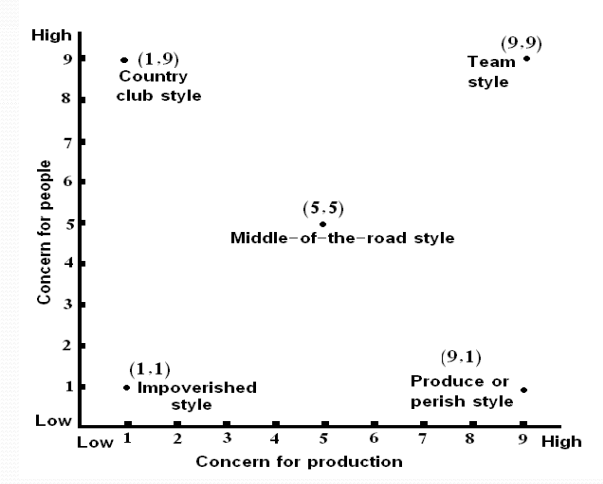
Indifferent or Impoverished Style (1,1):
- Low concern for both production and people.
- Leaders are primarily focused on avoiding responsibility for mistakes, which can stifle innovation.
Accommodating or Country Style (1,9):
- Low concern for production and high concern for people.
- Leaders prioritize the comfort and well-being of employees, resulting in a friendly but potentially less productive atmosphere.
Dictatorial or Perish Style (9,1):
- High concern for production and low concern for people.
- Leaders view employee needs as unimportant and emphasize performance through strict rules and punishments to achieve organizational goals.
Sound or Team Style (9,9):
- High concern for both production and people.
- Leaders adopting this style encourage teamwork and commitment among employees, seeking a balance between achieving goals and meeting the needs of the workforce.
Status Quo or Middle of the Road Style (5,5):
- Managers using this style attempt to strike a balance between company goals and employee needs.
- By giving moderate concern to both production and people, managers aim to achieve acceptable performance without fully satisfying either concern.
Effective leaders may adopt different styles based on the specific situation and the needs of their team or organization. The Managerial Grid provides a framework for understanding and adapting leadership behaviors to align with the goals and people involved.
Leadership Theories
-
The Trait Approach of Leadership is a leadership theory that emphasizes the role of specific personality traits, characteristics, and qualities in distinguishing effective leaders from others. This approach suggests that individuals possess inherent traits or qualities that predispose them to leadership roles.
-
Unlike the Trait Approach, which emphasizes inherent traits, this approach suggests that leadership capability can be learned and developed through certain behaviors. This approach asserts that effective leadership is not solely determined by inherent traits but can be acquired and developed through learned behaviors.
- People-oriented behavior: Leaders with people-oriented behavior prioritize positive relationships with their subordinates. They show empathy, concern for their well-being, and a willingness to listen to their suggestions and concerns.
- Task-oriented behavior: Leaders with task-oriented behavior focus on achieving specific objectives and ensuring that tasks are completed efficiently. They emphasize following organizational rules, meeting deadlines, and pushing employees to reach their performance potential.
-
The Contingency or Situational Approach of Leadership recognizes that the most effective leadership style depends on the specific situation at hand. This theory posits that a leader’s behavior and actions are influenced by the characteristics and demands of the situation. Leaders who can adapt their leadership style to match the situation are more likely to be successful.
-
Directive Leadership: In certain situations, a directive or task-oriented leadership style may be most effective. This involves providing clear instructions, setting performance standards, and closely supervising tasks to ensure they are completed as specified.
-
Supportive Leadership: Supportive or people-oriented leadership is appropriate in situations where building positive relationships and maintaining a pleasant work environment are key. Leaders who exhibit this style are approachable, respectful, and create a friendly atmosphere.
-
Participative Leadership: When the input and ideas of team members are valuable, participative leadership comes into play. Leaders who adopt this style consult with employees, listen to their suggestions, and involve them in decision-making processes.
-
Achievement-Oriented Leadership: In situations where challenging goals and high performance are essential, achievement-oriented leadership is effective. Leaders set ambitious targets, expect employees to excel, and convey confidence in their ability to meet these goals.
-
-
The Integrated Approach to Leadership is a comprehensive perspective that considers various factors and elements when analyzing and understanding leadership within an organization. This approach acknowledges that leadership is a multifaceted concept influenced by a combination of factors.
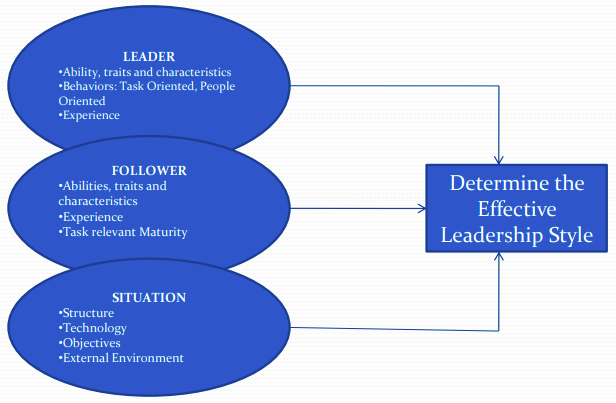
Entrepreneurship
Entrepreneurship is the dynamic process of identifying, creating, and pursuing innovative opportunities to establish and grow new businesses or ventures.
It involves the willingness and ability of individuals, known as entrepreneurs, to take calculated risks, allocate resources, and apply their creativity, skills, and knowledge to bring novel ideas, products, services, or solutions to the market.
Entrepreneurship is driven by the desire to create value, solve problems, and achieve economic success, often with a focus on profitability and sustainability. It plays a pivotal role in economic development, job creation, and technological advancement, making it a cornerstone of innovation and progress in societies worldwide.
Entrepreneurs are often characterized by their high aptitude, innovation, and pioneering spirit. They possess qualities and traits that set them apart from the general population.
Encouraging and fostering entrepreneurship is essential for economic development. Entrepreneurship development involves creating an environment where individuals with innovative ideas can transform them into viable businesses.
Various factors influence entrepreneurship, including access to resources, education, regulatory environment, and cultural attitudes toward risk-taking.
Characteristics:
- Initiative: Entrepreneurs take proactive action that goes beyond job descriptions and requirements. They are driven to create opportunities.
- Opportunity Seeking: Successful entrepreneurs have a keen eye for identifying and seizing opportunities. They act quickly when they spot a chance for innovation or growth.
- Discipline and Confidence: Entrepreneurs display discipline in working toward their goals and are confident in their ability to make their businesses succeed.
- Risk Taking: Entrepreneurs are willing to take calculated risks. While they aren’t reckless gamblers, they understand that uncertainty is part of the entrepreneurial journey.
- Creativity: Creativity and innovation are crucial traits. Entrepreneurs need to come up with novel solutions to problems and differentiate themselves in the market.
- Competitiveness: Many entrepreneurs start businesses because they believe they can outperform competitors. They have a strong desire to win and succeed.
- Commitment and Determination: Entrepreneurs are deeply committed to excellence and are determined to overcome obstacles. They persist in the face of challenges and failures.
- Strong People Skills: Successful entrepreneurs excel in motivating and leading their teams. They know how to communicate effectively and coach others to success.
- Strong Work Ethic: Entrepreneurs often work long hours and are highly dedicated to their ventures. They prioritize their businesses and stay focused on their work.
- Motivation: Entrepreneurs inspire their teams to share their vision and work towards common goals. They are skilled at motivating others to align with their objectives.
These characteristics are instrumental in the success of entrepreneurs as they navigate the challenges and opportunities of starting and growing businesses.
The Promotion of Entrepreneurship
Promoting entrepreneurship is vital for several reasons:
-
Economic Growth: Entrepreneurship has the potential to drive economic growth. Governments should encourage and support entrepreneurial activities as they can contribute significantly to a country’s economic development.
-
Job Creation: Entrepreneurs create job opportunities not only for themselves but also for others. Startups and small businesses are often significant sources of employment, which can help reduce unemployment rates.
-
Innovation and Creativity: Entrepreneurs are known for their innovative thinking. They introduce new products, methods of production, and ways to address market needs. Their creativity fuels progress and enhances competitiveness.
-
Small Business Development: Small businesses play a crucial role in the economy. They serve as engines of growth and innovation, providing diversity to industries and contributing to economic resilience.
-
Market Expansion: Entrepreneurs identify and develop new markets, both domestically and internationally. This expansion can lead to increased trade and economic opportunities.
-
Resource Utilization: Entrepreneurs find and tap into fresh sources of raw materials, which can help optimize resource utilization and reduce waste.
-
Change and Adaptation: Entrepreneurs are agents of change. They are quick to adapt to evolving market conditions and can lead industries in adopting new technologies and practices.
-
Youth Engagement: Encouraging entrepreneurship among young people is essential. Global Entrepreneurship Week and similar initiatives inspire and educate youth about entrepreneurship, fostering a culture of innovation and self-reliance.
In summary, promoting entrepreneurship is not only about creating businesses but also about fostering a culture of innovation, job creation, and economic growth. Governments, organizations, and societies should actively support and celebrate entrepreneurship to harness its many benefits.
Management Information System
A Management Information System (MIS) is a structured and integrated system designed to evaluate, create, implement, manage, and leverage information within an organization to enhance efficiency and support decision-making processes.
MIS gathers, analyzes, and organizes data from both internal and external sources, making it accessible to managers for the purpose of planning, organizing, directing, coordinating, and controlling various aspects of the organization’s operations.
Importance
-
Central Nervous System of an Organization: MIS can be compared to the central nervous system of an organization. Just as the nervous system processes and disseminates information throughout the body, MIS processes and disseminates information throughout an organization.
-
Supports Decision-Making: Managers rely heavily on information when making decisions. MIS provides managers with timely and relevant data that has been processed from raw information.
-
Performance Measurement: MIS helps measure an organization’s performance against its goals and benchmarks. It provides data on key performance indicators (KPIs), allowing managers to assess whether the organization is meeting its targets or if adjustments are needed.
-
Functional Applications: Different departments within an organization rely on MIS for specific functions. For example: Production Managers: They use MIS to access information related to production costs, labor costs, and the need for plant expansion to meet increased demand, Marketing Managers: MIS supports marketing efforts by providing data on sales trends, market analysis, and information necessary for new product development, Personnel Managers: MIS helps in managing the workforce by providing information on turnover rates, employee skills, wage structures, and incentive programs.
-
Efficiency and Effectiveness: MIS streamlines processes and ensures that information is available when and where it is needed. This increases the efficiency of operations and the effectiveness of decision-making.
-
Strategic Planning: MIS plays a crucial role in strategic planning. It provides data and analysis that guide the formulation of long-term strategies and plans, helping organizations adapt to changing market conditions.
Functions:
- Data capturing
- Data processing
- Function of prediction
- Function of planning
- Function of controlling
- Function of assistance
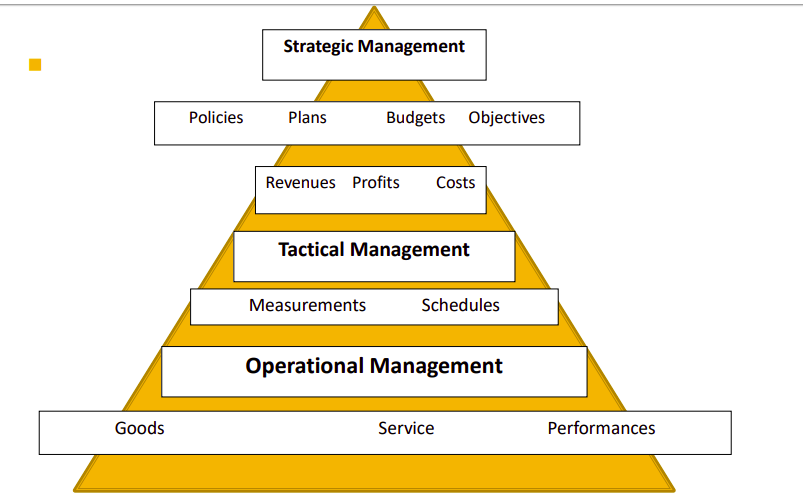
Here’s the information presented in tabular form:
| Management Level | Role | Information Needs | Information Frequency | Focus |
|---|---|---|---|---|
| Operational Management | Overseeing day-to-day operations | Detailed data on raw materials, work schedules, operational efficiency | Hourly or Daily | Ensuring goods/services meet schedules and customer expectations |
| Tactical Management | Implementing overall plans/strategies | Control procedures, resource allocation, alignment with organizational objectives | Weekly or Monthly | Aligning operational systems with organizational goals, economic factors |
| Strategic Management | Setting corporate policies/strategies | Long-term planning, goal achievement, overall profitability | Quarterly or Yearly | Setting future-oriented goals, assessing organizational objectives, external information |
This table summarizes the roles, information needs, information frequency, and focus of management at different levels within an organization, highlighting the role of Management Information Systems (MIS) in decision support.
Information System for Decision-Making Process:
Management Information Systems (MIS) serve as a technique that provides managers with valuable information to assist in the decision-making process.
Decision making involves choosing the best alternative, and having access to more information helps in making informed decisions.
-
Strategic Level Decision Making: At the strategic level, decisions are future-oriented and involve long-range planning. Executives focus on setting long-term goals and objectives.
-
Tactical Level Decision Making: Tactical managers make decisions related to short-term activities. This includes formulating budgets, managing funds, addressing personnel issues, and improving products or services.
-
Operational Level Decision Making: Operational decisions relate to day-to-day activities, such as inventory management, scheduling, and worker allocation.
In summary, the information needs of managers vary depending on their level within the organization, and MIS plays a crucial role in providing the right information at the right time to support effective decision making across all management levels.
Key Differences:
-
Scope: MIS focuses on routine operational and managerial tasks, providing historical and current data. In contrast, DSS is designed for complex and unstructured decision-making, offering tools for analyzing alternatives and exploring scenarios.
-
Data Handling: MIS primarily deals with structured data collected from standard business processes. DSS incorporates structured, semi-structured, and unstructured data, making it more versatile.
-
Interactivity: DSS provides a high level of interactivity, allowing users to manipulate data and models, perform sensitivity analysis, and explore multiple decision paths. MIS offers limited interactivity in comparison.
-
Decision Types: MIS supports day-to-day operational and managerial decisions. DSS caters to a broader range of decisions, including strategic planning, problem-solving, and scenario analysis.
-
User Audience: While both MIS and DSS are used by managers and decision-makers, DSS is more commonly employed by senior executives and professionals facing complex, strategic decisions.