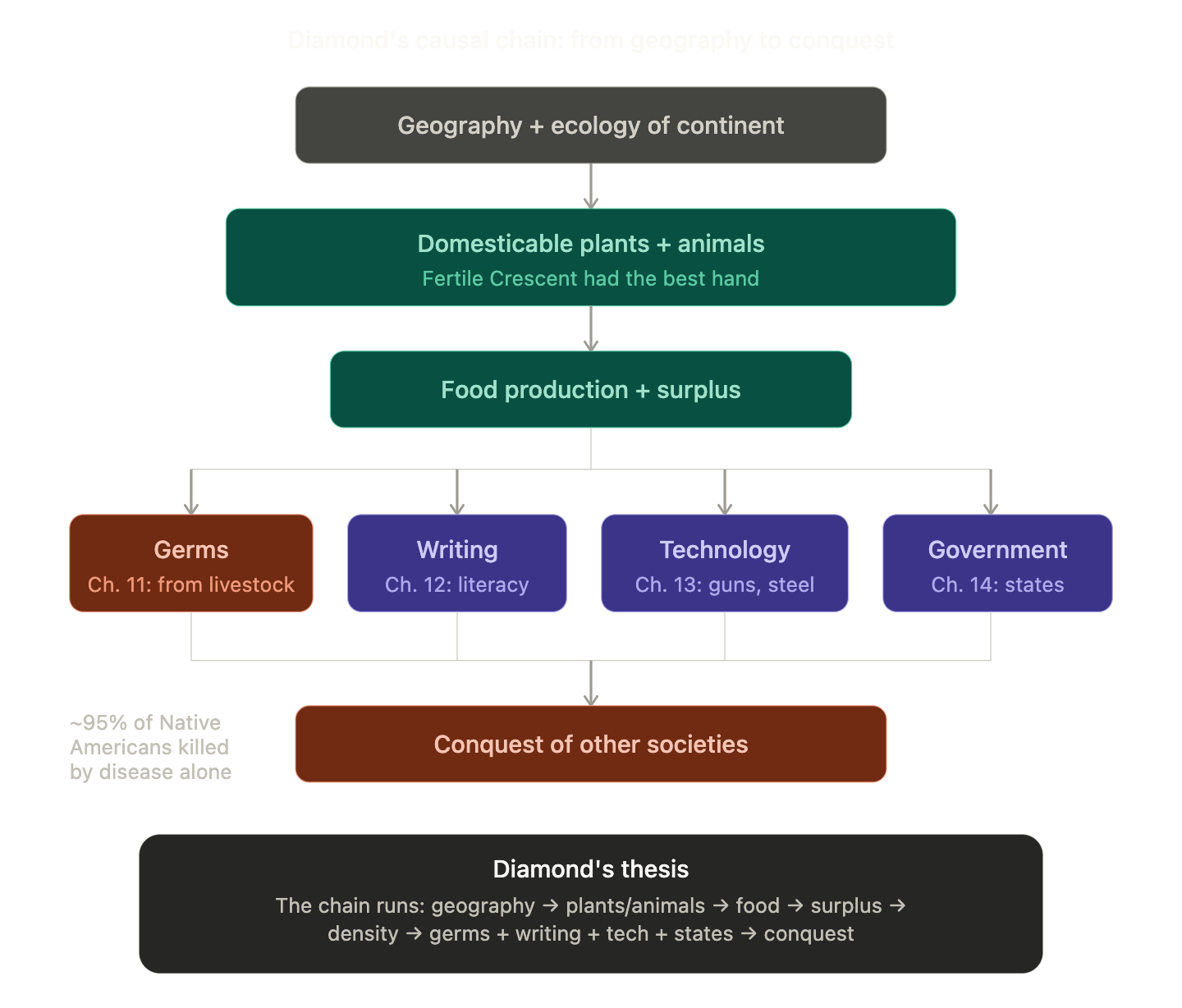
Diamond applies his complete framework to five regions, showing the same pattern everywhere: geography and ecology — not race or culture — determined which peoples conquered and which were conquered.
Yali’s People — Australia and New Guinea
The Puzzle
- Australia and New Guinea were joined as one landmass (Sahul) until ~10,000 years ago when rising sea levels separated them. Same ancestral population, same starting point.
- Yet by the 1800s: New Guinea had farming, pigs, permanent villages, dense populations. Australia had none — Aboriginal Australians remained hunter-gatherers with no farming, no metal, no writing, no dense settlements.
- Why the divergence?
New Guinea’s Partial Success
- New Guinea independently developed agriculture ~7000 BC — one of the earliest centers worldwide.
- Domesticated: taro, yams, bananas, sugarcane, some nut trees.
- But New Guinea’s agriculture had critical weaknesses:
- No cereal crops — taro and yams are starchy but low in protein compared to wheat, rice, or corn. Couldn’t support the same population density as cereal-based agriculture.
- No domesticable large animals — no cattle, sheep, goats, or horses. Pigs were introduced later from Southeast Asia, not independently domesticated.
- No metal — New Guinea had no tin or copper ores accessible with Stone Age technology.
- Extreme terrain — mountains, dense rainforest, valleys isolated from each other → produced the most linguistically diverse place on Earth (~1,000 languages). Extreme fragmentation prevented political unification.
- Result: New Guinea developed farming and dense highland populations, but never progressed beyond tribal or small chiefdom level. No writing, no states, no metal tools, no large-scale political organization.
Why Australia Stayed Hunter-Gatherer
- No domesticable plants — Australia had no native equivalent of wheat, barley, rice, corn, or taro. The wild plants available were either too low-yield or too difficult to cultivate. Aboriginal Australians had deep botanical knowledge but simply had nothing worth domesticating.
- No domesticable animals — all large mammals went extinct after human arrival ~40,000 years ago. The dingo arrived ~3500 BC from Southeast Asia but quickly went feral.
- Driest inhabited continent — most of interior Australia is arid desert with wildly unpredictable rainfall. Even hypothetical farming would have been extremely risky.
- Total isolation — Australia was cut off from Eurasia by ocean barriers. No crops, animals, or technologies could diffuse in from the Fertile Crescent or China, unlike Europe which received the full package.
- Low population density — without farming, populations stayed small and mobile → no surplus, no specialists, no chiefs, no states, no writing, no metal.
Aboriginal Australian Sophistication
- Diamond explicitly argues Aboriginal Australians were not less intelligent — he suggests they may have been subject to stronger natural selection for practical intelligence than Europeans, because surviving in Australia’s brutal environment demanded extraordinary skill.
- They developed: sophisticated fire-stick farming (deliberately burning landscape to encourage regrowth and drive game — a form of landscape management practiced for tens of thousands of years), the most complex kinship systems on Earth, elaborate Dreamtime spiritual traditions, unmatched tracking and navigation abilities, boomerangs, spear-throwers (woomeras), and other ingenious tools.
- Their “failure” to develop farming or states was entirely due to continental endowment, not capability.
The Torres Strait — A Natural Experiment
- Torres Strait Islanders lived on islands between Australia and New Guinea.
- Islands close to New Guinea adopted some farming. Islands close to Australia remained hunter-gatherers.
- This gradient demonstrates: proximity to farming cultures → adoption of farming. Australia was simply too far from any farming center for diffusion to occur.
European Colonization of Australia
- When Europeans arrived: Aboriginal Australians had no epidemic diseases to give Europeans (no livestock = no crowd diseases), but were devastated by European diseases — smallpox swept ahead of the frontier, killing people who had never seen a European.
- No farming → no surplus → no standing armies → no centralized political resistance to colonial invasion.
- European guns, steel, horses, and political organization against stone tools, small mobile bands, and zero immunity → rapid dispossession.
- Australia represents the most extreme case of Diamond’s thesis — the continent dealt the worst hand of all: smallest, driest, most isolated, zero domesticable plants, zero domesticable animals. Aboriginal Australians could not have done anything differently given what their continent offered them.
How China Became Chinese
The Puzzle
- China today appears culturally and linguistically unified — ~1 billion+ Mandarin speakers, dominated by Han Chinese.
- But China’s geography is as diverse as Europe’s — north vs. south, coast vs. interior, multiple river systems, deserts, mountains.
- Why did China unify into one dominant culture while Europe remained fragmented into dozens of nations?
China’s Two Agricultural Cradles
- North China (Yellow River / Huang He valley): independently domesticated millet (~7500 BC) in a dry temperate climate. Also domesticated soybeans, hemp, and silkworms.
- South China (Yangtze River valley): independently domesticated rice (~7500 BC or earlier) in a wet subtropical climate. Also domesticated water buffalo, pigs, ducks, and chickens.
- These were genuinely independent origins — different crops, different climates, different wild ancestors. China alone produced two of the world’s few independent agricultural revolutions.
The North-South Merger
- North and South China initially had different peoples, different languages, different cultures, different crops.
- Over millennia, northern Chinese (ancestors of Han) expanded southward, absorbing or displacing the indigenous peoples of South China.
- The original peoples of South China were linguistically diverse — speakers of Miao-Yao, Austroasiatic, Tai-Kadai, and Austronesian language families. They were pushed out:
- Austronesians → pushed to Taiwan, then expanded across the entire Pacific and Indian Oceans.
- Tai speakers → pushed to what is now Thailand, Laos, Vietnam.
- Miao-Yao speakers → pushed to highlands of southern China, Vietnam, Laos (the Hmong people).
- Austroasiatic speakers → pushed to Vietnam, Cambodia (Khmer people).
- The expansion was driven by the advantages of northern Chinese agriculture, political organization, and population density over the less densely populated southern groups. Same farmer-vs-farmer dynamic seen globally, except here it was rice-and-millet farmers with more political centralization overwhelming smaller-scale farming communities.
Why China Unified — Geography Favored It
- Two major east-west river systems (Yellow River in north, Yangtze in south) connected the interior with the coast and provided natural transportation corridors.
- Relatively few internal barriers compared to Europe — no equivalent of the Alps, Pyrenees, or Mediterranean Sea permanently dividing the landmass.
- The North China Plain is one of the largest flat expanses of fertile land in the world → supported huge, connected populations with easy communication and military movement.
- Early political unification — China was first unified under the Qin dynasty (221 BC) and has been mostly unified since, despite periodic breakups.
- Cultural homogenization followed political unification — a single writing system (Chinese characters work across all dialects/languages), centralized bureaucracy, standardized weights and measures, state ideology (Confucianism), and the imperial examination system all reinforced linguistic and cultural unity over centuries.
Why Europe Stayed Fragmented — The Contrast
- Europe has far more internal geographic barriers: Alps, Pyrenees, Carpathians, English Channel, North Sea, Baltic Sea, Mediterranean, Scandinavian mountains, Rhine/Danube dividing lines → natural borders that sustained separate kingdoms and cultures.
- No single dominant river plain connecting everything — instead, multiple separate river basins draining in different directions toward different seas.
- No single power could conquer all of Europe permanently (Rome came closest but eventually fell). Result: dozens of languages, nations, and cultures persisted to the present day.
The Double-Edged Sword of Unity
- China’s unity was both an advantage and a vulnerability:
- Advantage: rapid diffusion of innovations across the whole civilization, unified infrastructure, massive organized labor, enormous armies, cultural continuity.
- Vulnerability: a single emperor’s bad decision affected the entire civilization. Key examples:
- 1433 AD — an emperor banned construction of oceangoing ships, ended Zheng He’s treasure fleet voyages (which had reached East Africa with ships far larger than anything Europe had), and turned China inward. This single decision ended China’s maritime exploration permanently.
- At various points, Chinese emperors also abandoned or suppressed: mechanical clocks, water-powered spinning machines, and other technologies.
- In Europe, if one king rejected an innovation, a rival kingdom adopted it. Columbus was rejected by Portugal and France before Spain funded him. Competition between many states drove adoption. In China, one rejection meant rejection for the whole civilization.
- Diamond’s key insight: political fragmentation + competition (Europe) can sometimes drive faster innovation than political unity (China), even when the unified civilization has a technological head start. This helps explain why China, despite inventing gunpowder, printing, the compass, and paper, ultimately fell behind Europe technologically by the 1500s.
Speedboat to Polynesia — The Austronesian Expansion
The Puzzle
- The Austronesian language family is the most geographically spread pre-modern language family on Earth — from Madagascar (off East Africa) to Easter Island (near South America), from Hawaii (North Pacific) to New Zealand (South Pacific). Roughly half the world’s circumference.
- All trace back to a single ancestral language spoken in southern China/Taiwan ~6,000 years ago.
- How did one group of people come to dominate half the world’s ocean surface?
The Origin: Taiwan
- Linguistic evidence points to Taiwan as the Austronesian homeland — Taiwan has the greatest diversity of Austronesian languages (9 out of 10 primary branches are found only there). Greater diversity = longer occupation = origin point. Same logic used to identify Nigeria/Cameroon as the Bantu homeland.
- The ancestral Austronesians were farmers from southern China — part of the populations being displaced southward by expanding northern Chinese. They crossed to Taiwan ~4000–3000 BC.
- They brought a powerful package: rice, millet, pigs, chickens, dogs, pottery, and advanced sailing technology.
The Expansion — Stage by Stage
- From Taiwan, Austronesians expanded in stages over ~5,000 years:
- Taiwan → Philippines (~3000 BC)
- Philippines → Indonesia / Borneo / Sulawesi (~2500 BC)
- Indonesia → coastal New Guinea and Melanesian islands (~1600 BC) — this is the Lapita culture, identified by distinctive pottery found across a vast island chain.
- Melanesia → Fiji, Tonga, Samoa (~1200 BC) — the gateway to Polynesia.
- Western Polynesia → Hawaii (~500 AD) — 2,400 miles north into open Pacific.
- Western Polynesia → Easter Island (~500–800 AD) — 2,200 miles east, the most remote inhabited island on Earth.
- Western Polynesia → New Zealand (~1200 AD) — 1,600 miles southwest, the last major habitable landmass settled by humans.
- Indonesia → Madagascar (~500 AD) — a staggering 4,000-mile open ocean crossing to an island off the coast of Africa. Madagascar’s primary language (Malagasy) is Austronesian, not African. The Malagasy people have visible Southeast Asian ancestry mixed with later African Bantu ancestry. This is the most surprising migration in human history — an African island speaking a Bornean language.
Why Austronesians Succeeded — The Same Pattern Again
- Food production advantage — Austronesians were farmers with a full package (rice, root crops, pigs, chickens). When they encountered hunter-gatherer populations across island Southeast Asia, they had higher population density and overwhelmed them.
- Superior maritime technology — double-hulled canoes, outrigger canoes, advanced navigation by stars, ocean currents, wave patterns, and bird migration routes. No other culture at the time had comparable ocean-sailing capability.
- The farmer/hunter-gatherer collision — at every stop, the same dynamic: Austronesian farmers arrived → population grew faster than indigenous hunter-gatherers → expanded at their expense. Identical to the Bantu expansion in Africa and the European expansion in the Americas.
What Happened at New Guinea — The Limit
- New Guinea’s interior was already densely populated by indigenous New Guinean farmers who had independently developed agriculture ~7000 BC — thousands of years before Austronesians arrived.
- Austronesians could NOT penetrate inland New Guinea — the indigenous farming population was too large, too established, and too dense. Farming New Guineans couldn’t be displaced the way sparse hunter-gatherers could.
- Austronesians colonized only the coastal fringes and offshore islands of New Guinea.
- This is why New Guinea today has both Austronesian-speaking coastal peoples and non-Austronesian (Papuan) inland peoples — the highlands were already “full.”
- Contrast with the Philippines and Indonesia, where indigenous hunter-gatherers were sparse and were almost entirely displaced. Only tiny remnant populations survive: Negritos in the Philippines (Aeta people), Andaman Islanders, some interior Borneo groups.
The Polynesian Radiation — Empty Land
- Once Austronesians reached the uninhabited islands of Polynesia (Fiji, Tonga, Samoa by ~1200 BC), they were colonizing empty land — no competition at all.
- From western Polynesia, they launched the most remarkable voyages in human history — reaching Hawaii, Easter Island, and New Zealand across thousands of miles of open ocean.
- Navigation: entirely by stars, wave patterns, bird flight, cloud formations — no instruments, no compass, no charts. One of the greatest achievements of human exploration ever.
Hemispheres Colliding — The Americas vs. Eurasia
The Puzzle
- By 1492, Eurasia had guns, steel, ocean-going ships, writing, horses, and epidemic diseases. The Americas had none of these (with limited exceptions). Why?
The Americas’ Disadvantages — A Complete Accounting
1. Fewer domesticable species
- The megafauna extinction (~11,000 years ago) wiped out horses, camels, mammoths, giant ground sloths — all potential domesticates, gone forever.
- Only one large domesticated mammal in the entire hemisphere: llama/alpaca (Andes only).
- Llama/alpaca limitations were severe: too small to ride, too weak to pull plows or heavy wagons, couldn’t be milked effectively, produced less wool than sheep, only lived in Andean highlands → never spread to Mesoamerica or North America, just 2,000 miles away.
- Corn (maize), the Americas’ most important crop, was extraordinarily difficult to domesticate. Wild teosinte — corn’s ancestor — had tiny cobs, hard seed casings, and a branching structure that looked nothing like modern corn. It took thousands of years of selective breeding to become productive. Wild wheat, by contrast, already looked and functioned close to its domesticated form.
2. North-south axis
- The Americas stretch 9,000 miles north to south but are relatively narrow east to west.
- Crops and animals couldn’t spread:
- Corn took ~3,000 years to reach eastern North America from Mexico.
- Llamas/alpacas never left the Andes despite thousands of years — never reached Mesoamerica.
- Mesoamerican turkeys never reached South America.
- The wheel was invented in Mexico (used in children’s toys) but never adopted for transport — without draft animals to pull vehicles, wheels were useless for heavy work.
- Writing was invented by the Maya but never reached the Andes or North America.
3. Geographic barriers
- Isthmus of Panama: narrow, tropical, ecologically different from both continents → major bottleneck.
- Mexican desert: blocked northward crop spread from Mesoamerica.
- Tropical lowlands of Central America: highland crops from Mexico and the Andes couldn’t survive crossing the hot, wet lowlands.
- These barriers meant American civilizations developed largely in isolation from each other. The Inca knew nothing of the Maya. The Aztec knew nothing of Cahokia.
4. Late start
- Americas were colonized by humans ~14,000 years ago (vs. millions of years in Africa/Eurasia).
- Food production began ~3500 BC in Mesoamerica (vs. ~8500 BC in Fertile Crescent) — a 5,000-year head start for Eurasia.
- That gap compounded: earlier farming → earlier surplus → earlier writing → earlier metallurgy → earlier states → earlier professional armies. Each advantage built on the last.
5. No epidemic diseases
- Almost no domesticated animals → almost no animal-to-human disease transfer → no crowd diseases.
- When Europeans arrived, Native Americans had zero immunity to smallpox, measles, influenza, typhus, plague.
- ~95% population collapse — the single most devastating factor in European conquest. Entire civilizations were gutted by disease before European armies even reached them.
What the Americas Did Achieve
- Despite every disadvantage, American civilizations accomplished extraordinary things:
- Maya: independently invented writing (hieroglyphics), developed advanced astronomy and mathematics (including the concept of zero — independently of India), built monumental stone architecture, created complex calendar systems accurate to within seconds per year.
- Aztec: built Tenochtitlan — a city of 200,000+ people on an island in a lake, larger than any European city at the time. Elaborate markets, aqueducts, causeways, floating gardens (chinampas) that were among the most productive agricultural systems ever devised.
- Inca: built the largest empire in the Americas (~2,500 miles long, 10–12 million people), an extraordinary road system (25,000+ miles through mountains, deserts, and jungles), suspension bridges over deep gorges, sophisticated agricultural terracing (still used today), massive stone architecture without mortar (Machu Picchu, Sacsayhuamán — stones fit so precisely you can’t slide a razor blade between them), and the quipu (knotted string record-keeping system that encoded complex administrative data without traditional writing).
- Cahokia (near modern St. Louis): population of 10,000–20,000 around 1100 AD, the largest settlement north of Mexico, with massive earthen mounds rivaling Egyptian pyramids in volume.
- Diamond’s point: these achievements prove Native Americans were fully as capable as any other humans. They were simply working with a vastly inferior hand of geographic and ecological cards.
The Collision
- When Columbus arrived in 1492, the asymmetry was total:
- Europe had: guns, steel swords and armor, horses, oceangoing ships, writing, centralized states with professional armies, and epidemic diseases.
- The Americas had: no guns, no steel (bronze and stone only), no horses (extinct 10,000 years earlier), no oceangoing ships, limited writing (Maya only, never spread), some states (Aztec, Inca) but fragmented and isolated from each other, and no epidemic diseases to send back.
- The result was inevitable given these asymmetries — not because Europeans were superior people, but because Eurasia was a superior continent for developing the tools of conquest.
How Africa Became Black
This is the most complex and complete case study in the book — Diamond applies every element of his framework to explain the entire demographic history of a continent.
The Puzzle
- Modern sub-Saharan Africa is dominated by Black (Bantu-speaking) peoples, but Africa actually contains the greatest genetic, linguistic, and phenotypic diversity of any continent — more than the rest of the world combined.
- Africa is the continent where humans have lived the longest (~7 million years of hominid evolution) → the most time for genetic diversification.
- Five major populations historically occupied Africa:
- Blacks — the largest group, dominant across most of sub-Saharan Africa. Most speak Bantu languages (a subfamily of the Niger-Congo family, ~500+ languages). Also includes non-Bantu Niger-Congo speakers in West Africa, plus Nilo-Saharan speakers in East/Central Africa (e.g., Maasai, Dinka, Nuer).
- Whites (Berbers, Arabs) — North Africa, above the Sahara. Physically and linguistically related to Middle Eastern/European populations. Speak Afro-Asiatic languages (Arabic, Berber, ancient Egyptian).
- Pygmies — Central African rainforests (e.g., Mbuti, Aka, Baka, Twa). Characteristically short stature (average male height ~4’11”), hunter-gatherers, among the most ancient populations on Earth genetically. Today most speak Bantu languages adopted from their neighbors, but likely originally had their own languages (now lost).
- Khoisan (Bushmen/San + Hottentots/Khoi) — Southern Africa. The San are hunter-gatherers; the Khoi were herders (acquired cattle/sheep from Bantu contact). Famous for click languages (using consonant clicks as phonemes — found nowhere else on Earth except in a few neighboring Bantu languages that borrowed them). Genetically among the most ancient and distinct human lineages. Once occupied much more of eastern and southern Africa — archaeological and genetic evidence shows click-language speakers in East Africa (Tanzania) thousands of years ago.
- Austronesians — Madagascar. Arrived from Indonesia ~500 AD. Malagasy people speak an Austronesian language and have visible Southeast Asian ancestry mixed with African Bantu ancestry. Madagascar is the world’s most surprising linguistic anomaly — an island 250 miles off Africa speaking a language from 4,000 miles away in Borneo.
The Bantu Expansion — Africa’s Most Important Demographic Event
- The Bantu expansion is one of the largest and most consequential population movements in human history — comparable to the Austronesian expansion across the Pacific, the Indo-European expansion across Eurasia, or the European colonization of the Americas.
- Origin: Bantu languages trace back to an ancestral homeland in southeastern Nigeria / Cameroon, based on linguistic evidence (greatest diversity of Bantu languages found there — same logic used for Taiwan as the Austronesian homeland). The word “Bantu” itself means “people” in many Bantu languages.
- Timeline: began ~3000 BC, reached southern Africa by ~500 AD. Roughly 3,500 years to sweep across the continent — averaging ~1 mile per year but in reality happening in waves and pulses.
- The expansion was not a single organized migration — it was a slow, cumulative demographic wave of farming communities budding off, moving into new territory, growing, and budding off again, generation after generation.
Why the Bantu Expanded
- Bantu peoples were farmers — they had domesticated crops from the Sahel agricultural package: sorghum, pearl millet, African yams, oil palm, cowpeas, black-eyed peas. Later also acquired: bananas, Asian yams, taro (from Austronesians via East African trade — a crucial addition that allowed farming in the wet tropical forest zone where African cereals like sorghum and millet could not grow). Without bananas, the Bantu could not have penetrated the central African rainforest — this Austronesian contribution reshaped Africa’s demographic history.
- They had iron — the Bantu were among the first sub-Saharan Africans to smelt iron. This gave them:
- Iron axes to clear dense tropical forest for farming plots.
- Iron hoes for more efficient cultivation than wooden digging sticks.
- Iron spear and arrow points far superior to the stone/bone weapons of hunter-gatherers.
- Iron smelting in sub-Saharan Africa may have been independently invented (debate continues), and notably, many African societies went directly from stone to iron without a bronze age — unlike Eurasia’s stone → copper → bronze → iron sequence.
- They had pottery — allowed food storage, cooking of grains, and beer brewing (socially important).
- Higher population density — farming + iron tools → more food per acre → 10-100x more people per square mile than hunter-gatherers. Sheer numbers overwhelmed the sparse populations they encountered.
- The peoples they displaced — Pygmies in the central African rainforest and Khoisan across eastern and southern Africa — were hunter-gatherers with stone tools, no farming, no iron, and critically lower population density. They simply could not compete demographically.
The Pattern of Displacement — Diamond’s Framework in Action
- The Bantu expansion followed the exact same pattern as every other farmer-vs-hunter-gatherer collision in human history (Europeans vs. Aboriginal Australians, Austronesians vs. Negrito hunter-gatherers in Philippines, early European farmers vs. Mesolithic hunter-gatherers):
- Bantu farmers moved into new territory → cleared forest with iron axes → planted crops → population grew → expanded further → displaced, absorbed, or marginalized hunter-gatherers.
- Pygmies were pushed into the deepest, most inaccessible parts of the central African rainforest — the areas least suitable for farming, where Bantu agriculture couldn’t easily follow. Many Pygmy groups adopted Bantu languages (their original languages are almost entirely lost) while maintaining their distinct genetic identity, physical characteristics, and hunter-gatherer lifestyle. Some developed trade relationships with neighboring Bantu farmers (exchanging forest products for iron tools and farm produce). Today they number only ~200,000–500,000 total across several countries (DRC, Congo, Cameroon, Central African Republic, Rwanda, Burundi).
- Khoisan were pushed to the extreme southwest of Africa — the Kalahari Desert and the Cape region — the driest, least farmable parts of the continent where Bantu crops couldn’t grow. Before the Bantu expansion, Khoisan peoples occupied much of eastern and southern Africa:
- Archaeological evidence of Khoisan-type skeletal remains in East Africa (Kenya, Tanzania).
- The Hadza and Sandawe peoples of Tanzania still speak click languages today — linguistic remnants of the formerly widespread Khoisan presence in East Africa, now surrounded by Bantu-speaking populations.
- Today the San (Bushmen) number ~100,000, mostly in Botswana/Namibia/Angola. The Khoi were largely absorbed by Bantu and later European colonizers in South Africa.
- Some Khoisan were not just displaced but absorbed — several southern Bantu languages (Zulu, Xhosa, Sotho) borrowed click consonants from Khoisan languages, proving direct contact and intermarriage. Nelson Mandela’s Xhosa language contains clicks inherited from Khoisan.
Two Routes of Expansion
- Diamond traces two main routes of Bantu expansion:
- Western route: from Nigeria/Cameroon through the central African rainforest → then south through Angola/Congo into southern Africa.
- This route was initially blocked — sorghum and millet (savanna crops) can’t grow under the rainforest canopy.
- The breakthrough: adoption of bananas, Asian yams, and taro from Southeast Asian/Austronesian traders who had reached East Africa’s coast. These tropical crops thrived in wet forest environments.
- With bananas, Bantu farmers could farm inside the rainforest for the first time → opened the western route through Congo Basin.
- This is one of history’s great examples of crop diffusion changing everything — a plant from Southeast Asia enabled an African population expansion.
- Eastern route: from the homeland east and then south around the north side of the rainforest, through the East African highlands (Great Lakes region — modern Uganda, Rwanda, Burundi, Kenya, Tanzania) → then south through Mozambique, Zimbabwe, to South Africa.
- This route followed open savanna and highland environments where sorghum/millet grew well.
- In East Africa, Bantu farmers encountered and mixed with Nilo-Saharan-speaking pastoralists (cattle herders like the ancestors of the Maasai, Tutsi, Dinka) — creating complex interactions between farming and herding peoples.
- The eastern route brought Bantu speakers into contact with the Indian Ocean trade network → acquiring additional crops, technologies, and eventually connecting to Arab and later Portuguese traders.
- Western route: from Nigeria/Cameroon through the central African rainforest → then south through Angola/Congo into southern Africa.
- Both routes converged in southern Africa by ~300–500 AD.
- The Bantu expansion was halted in the far southwest by two factors:
- Mediterranean/winter-rainfall climate of the Cape region — Bantu tropical crops (sorghum, millet, bananas) couldn’t grow in this climate. The Khoisan survived here precisely because Bantu agriculture didn’t work.
- Tsetse fly belt — in some areas, the tsetse fly (which causes sleeping sickness in cattle) prevented Bantu herders from keeping livestock, slowing expansion.
Why Africa’s History Is Different From Eurasia’s — The Full Framework Applied
- Diamond systematically applies every element of his framework to explain Africa’s trajectory:
1. North-south axis
- Africa’s main axis runs north-south → crops and animals couldn’t spread easily across different climate zones.
- A crop domesticated in the Sahel (tropical, summer rainfall) can’t grow in the Mediterranean climate of North Africa or the Cape (winter rainfall). A crop from the Ethiopian highlands can’t grow in the Congo lowlands.
- Compare Eurasia: wheat spread from the Fertile Crescent to Britain to India to China across thousands of miles of similar latitude.
2. Sahara Desert — the great barrier
- The Sahara is the world’s largest hot desert — 3.6 million square miles of nearly impassable sand, rock, and extreme heat.
- It divided Africa into two separate worlds: North Africa (which received the full Fertile Crescent package — wheat, barley, cattle, sheep, goats, horses, writing, metalworking — and was part of the Mediterranean/Middle Eastern cultural sphere) and sub-Saharan Africa (which had to develop everything independently).
- Fertile Crescent wheat and barley could not cross the Sahara — they need winter rain and temperate climates. The tropical Sahel on the Sahara’s southern edge had summer rain → Fertile Crescent crops failed there.
- Some technologies and animals did eventually trickle across (cattle, possibly ironworking techniques, Islam) but the barrier enormously slowed diffusion compared to Eurasia’s open corridors.
3. Equatorial rainforest — the second barrier
- Even within sub-Saharan Africa, the Congo Basin rainforest formed another major barrier between West Africa and East/Southern Africa.
- Savanna crops couldn’t grow under the canopy. Only after bananas arrived from Southeast Asia could farmers penetrate it.
4. Few domesticable large animals
- Despite having the most large mammal species of any continent (~50+ species of large wild herbivores), Africa had almost no domesticable candidates:
- Zebras: notoriously vicious temperament, bite and don’t let go, duck lassos, have injured more zookeepers than any other animal. Every attempt at domestication has failed despite centuries of European efforts.
- African buffalo (Cape buffalo): extremely aggressive, unpredictable, kills hundreds of people annually. Often called the most dangerous large animal in Africa.
- Hippos: territorial, aggressive, kill more people in Africa than any other large animal (~500/year). Spend most of time in water → impractical.
- Rhinos: solitary, aggressive, too dangerous.
- Elephants: can be tamed individually (as in Asia) but never truly domesticated (bred in captivity). Too slow-growing (15+ years to maturity), too dangerous, too much food needed.
- Various antelope species: most panic in enclosures (gazelle, eland had limited success), solitary or territorial rather than herd-dwelling with dominance hierarchies.
- Result: sub-Saharan Africans had to rely on cattle, sheep, and goats acquired from the Middle East via the Sahara — not indigenous species. And even these couldn’t be kept in large parts of Africa due to the tsetse fly.
5. Tropical diseases — Africa’s unique burden
- Africa’s tropical environment harbored diseases devastating to both humans and livestock:
- Malaria: the single biggest killer in African history, transmitted by Anopheles mosquitoes. Endemic across tropical Africa. Severely debilitated populations and later killed European colonizers in enormous numbers.
- Yellow fever: viral disease transmitted by mosquitoes. Another major killer.
- Sleeping sickness (trypanosomiasis): caused by parasites transmitted by the tsetse fly. Affects both humans and cattle. The tsetse belt covers roughly 10 million square kilometers of sub-Saharan Africa — in these zones, cattle cannot survive → no plowing, no dairy, no draft animals. This removed one of the key advantages of animal domestication across huge areas.
- River blindness (onchocerciasis): made fertile river valleys in West Africa uninhabitable.
- These diseases slowed African development but later partially protected Africans from European colonization — European soldiers died in such numbers from malaria and yellow fever that West Africa was called “the white man’s grave,” delaying full colonization by centuries.
6. Later start on food production
- Sub-Saharan Africa’s independent agriculture (Sahel ~5000 BC) started ~3,500 years later than the Fertile Crescent (~8500 BC).
- Africa’s crops — sorghum, millet, yams — were less productive per unit of labor than wheat, barley, or rice.
- No cereal-based agriculture in the forest zone until bananas arrived.
- Later start → later surplus → later states → later technology → compounding disadvantage relative to Eurasia.
What Africa Did Achieve — Despite Every Handicap
- Despite every geographic disadvantage, Africa produced remarkable civilizations. Diamond emphasizes these to prove his point that the people were not the problem, the continent was:
- Independent invention of ironworking — sub-Saharan Africa smelted iron independently (debate continues about timeline). Uniquely, many societies skipped bronze entirely, going directly from stone to iron — suggesting independent development rather than simple diffusion.
- Complex states and empires:
- Ghana Empire (~300–1200 AD) — controlled the trans-Saharan gold trade.
- Mali Empire (~1235–1600 AD) — Mansa Musa’s pilgrimage to Mecca in 1324 distributed so much gold he crashed economies along his route. Possibly the richest person who ever lived. Timbuktu became a center of Islamic scholarship with a university.
- Songhai Empire (~1464–1591) — largest empire in African history at its peak.
- Great Zimbabwe (~1100–1450 AD) — massive stone ruins built without mortar, trade center connecting interior gold to Indian Ocean commerce.
- Kingdom of Kongo (~1390–1914) — centralized state in Central Africa with sophisticated political structure.
- Ethiopian Empire — one of the oldest continuous states in the world, with its own unique Christianity (adopted ~4th century AD), its own writing system (Ge’ez), its own architectural tradition (rock-hewn churches of Lalibela).
- Zulu Kingdom (early 1800s) — Shaka Zulu transformed a small chiefdom into a military power that dominated southern Africa and initially resisted European colonization effectively.
- Swahili city-states (East African coast) — Kilwa, Mombasa, Zanzibar — wealthy trading cities connecting Africa to Indian Ocean commerce with Arabia, India, and China.
- Independent writing: Ethiopian Ge’ez script (~5th century BC, still used today for Amharic). Nsibidi script in Nigeria.
- Independent crop domestication: sorghum, pearl millet, African rice (Oryza glaberrima — entirely separate species from Asian rice), teff, finger millet, coffee, yams, oil palm, watermelon, okra, kola nut.
- World-class art: Benin bronzes (among the finest bronze sculptures ever produced, rival or surpass European contemporaries), Nok terracottas, the griot oral history tradition, complex polyrhythmic music that later shaped jazz, blues, and rock.
The European Colonization — Why It Happened So Late
- European colonization of Africa was dramatically different from the Americas:
- Africans were NOT devastated by European diseases to the same degree — sub-Saharan Africa had some exposure to Old World diseases through Saharan and Middle Eastern trade routes over millennia, building partial immunity. (Though smallpox still caused serious epidemics.)
- African tropical diseases killed Europeans instead — in some early British colonial garrisons, 50–80% of soldiers died within their first year from malaria and yellow fever.
- Africans had iron weapons and organized states — iron spears, swords, and organized armies. European superiority was real but not as overwhelming as in the Americas.
- Africans had horses and cavalry in savanna regions north of the tsetse belt.
- Result: full colonization came 350+ years after the Americas. The “Scramble for Africa” didn’t happen until the 1880s–1900s, finally enabled by:
- Quinine (anti-malarial, widely available from 1840s) — allowed Europeans to survive in tropical Africa for the first time.
- Maxim gun (first automatic machine gun, 1884) — gave decisive advantage over iron-armed African forces.
- Steamships — penetrated river systems into interior.
- Industrial-era political organization — nation-states could sustain overseas empires.
- The Berlin Conference (1884–85) divided Africa among European powers with lines on a map, with zero African representation — creating the arbitrary borders that still define the continent today.
Why This Chapter Is the Book’s Capstone
- Africa’s history involves every single factor from Diamond’s framework:
- Axis orientation → north-south blocked crop spread.
- Domesticable species → fewer crops, almost no domesticable animals.
- Food production and surplus → later start, less productive crops.
- Germs → tropical diseases both handicapped Africa and partially protected it from colonization.
- Writing → limited independent development, most of continent remained oral.
- Technology → independent ironworking but later development overall.
- Political organization → complex states, but later and smaller than Eurasia’s.
- Farmer vs. hunter-gatherer dynamics → the Bantu expansion, identical to global pattern.
- Diffusion barriers → Sahara and rainforest blocked flow of ideas and technology.
- Diamond’s conclusion: Africa’s peoples achieved everything their geography allowed and more. The differences between African and Eurasian history are fully explained by continental ecology and geography — axis, barriers, available species, disease environment — without invoking any differences in human ability.
Part 4 Summary: Each chapter applies the same framework to a different region. Australia’s fate was sealed by having no domesticable species and extreme isolation. China unified because its geography connected; Europe fragmented because barriers divided. The Austronesians show farmers with boats overwhelming hunter-gatherers across half the globe. The Americas lost to Eurasia because of fewer domesticable species, a north-south axis, devastating barriers, and a 5,000-year late start. Africa’s Bantu expansion mirrors the global farmer-vs-hunter-gatherer pattern, while Africa’s overall trajectory was shaped by its axis, the Sahara, undomesticable animals, and tropical disease. In every case, the same conclusion: geography and ecology determined the outcome, not the people.